.png)



1. What Is a Freeletics Clone Script?
A Freeletics clone script replicates the core idea behind Freeletics — AI-driven, bodyweight-heavy coaching that adapts training intensity to the user without needing a gym full of equipment — packaged as a Freeletics clone app you buy and rebrand instead of building from zero. It's an AI fitness app script with the AI logic, backend, and mobile frontend already wired together.
TrainBuddy AI is exactly that: an AI personal trainer app built on Flutter, Supabase, and Gemma AI, sold as ready-to-deploy Freeletics source code for founders and agencies who want a working AI-coached fitness product without the multi-month build. It's a real, functioning stack — not a demo — available now on the Arixlabs Marketplace.
2. Where Can You Get Freeletics Source Code Like TrainBuddy AI?
Searching for Freeletics source code usually turns up outdated UI kits with no real AI behind them — no coaching engine, no adaptive intensity logic, just screens that resemble Freeletics without the intelligence layer. TrainBuddy AI is different: it's a functioning AI gym coach app with a real coaching engine, backend, and admin tools, sold directly through the Arixlabs Marketplace.
Most Freeletics clone script listings elsewhere are frontend-only — they look right in screenshots, but there's no backend logic behind the screens the moment you try to connect a real AI model. TrainBuddy AI is built backend-first, AI-native from day one, which is what separates a working AI fitness app script from a static mockup.
Buying through a dedicated marketplace also means the Freeletics clone app has been used and shipped before, not just listed. That track record matters more than a lower price tag from an unknown source, especially when the alternative is discovering mid-build that your Freeletics source code doesn't actually run past the demo screen. For agencies pitching clients on an AI personal trainer app, sourcing proven code also removes the reputational risk of handing over something broken. And for solo founders without an in-house developer, buying through a marketplace where the listing has already been tested end to end is far less risky than sourcing an AI fitness app script from an anonymous forum post or a one-off freelancer.
3. What Features Come With This AI Personal Trainer App?
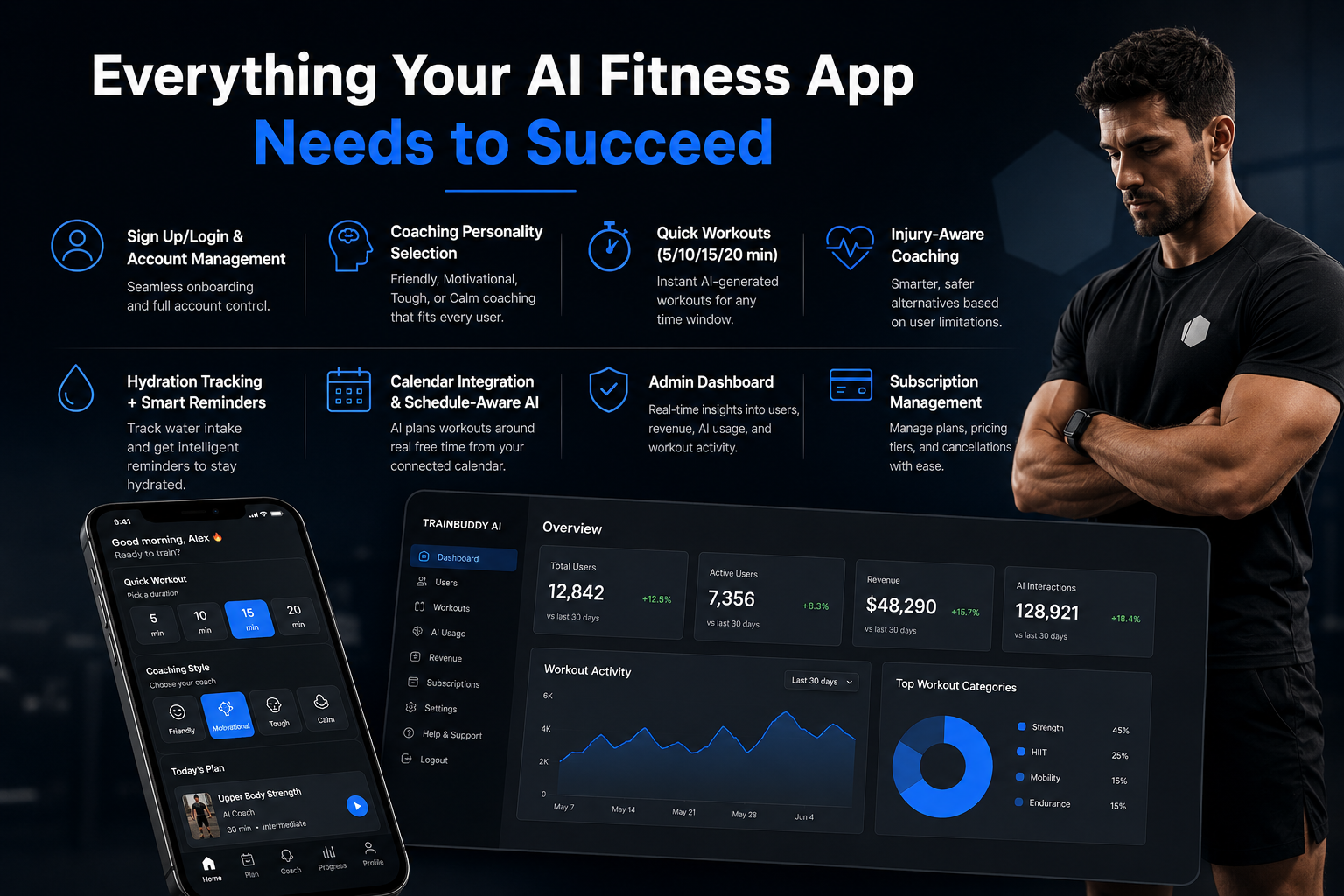
A serious AI personal trainer app needs to do more than show a workout list — it needs adaptive coaching, personalization, and admin tooling. TrainBuddy AI ships with a full 24-screen user app and a 14-screen admin dashboard, all wired into the Freeletics clone script you receive, so nothing on this list is a future promise.
- Sign Up/Login & Account Management — Users join in seconds via email, phone, or social login, with password reset and full profile/device management, so fewer people drop off before their first session.
- Coaching Personality Selection — Users choose between Friendly, Motivational, Tough, or Calm coaching styles that shape every check-in, turning this AI gym coach app into something that actually matches how the user wants to be pushed.
- Quick Workouts (5/10/15/20 min) — On short-time days, users generate an instant session with no manual planning — a key retention driver for any AI fitness app script.
- Injury-Aware Coaching — Users flag pain or limitations, and the AI responds with safer, lower-impact alternatives instead of a fixed generic plan.
- Hydration Tracking + Smart Reminders — Users log water intake and get context-aware nudges, extending engagement beyond the workout itself.
- Calendar Integration & Schedule-Aware AI — Connected calendars let the AI generate workouts that fit actual free time, removing "no time" as an excuse to skip training.
- Admin Dashboard — Real-time visibility into users, revenue, AI usage, and workout activity from one screen.
- Subscription Management — Admins manage plans, pricing tiers, and cancellations directly from the dashboard.
3.1 Can I Rebrand This Freeletics Clone App After Purchase?
Yes. Buying a Freeletics clone app doesn't mean shipping someone else's brand — TrainBuddy AI is built to be rebranded: your logo, your color palette, your app name. The underlying Freeletics source code and backend architecture stay the same, but nothing about the finished product looks templated to your end users.
3.2 Does This AI Fitness App Script Include Bodyweight or No-Equipment Coaching?
Yes. The Quick Workouts feature generates sessions built around whatever time and equipment a user has, and the AI coaching engine adjusts intensity and exercise selection accordingly — the same bodyweight-friendly, no-excuses premise that made Freeletics popular. Combined with injury-aware coaching, this AI personal trainer app can steer users toward safe, equipment-free alternatives whenever needed.
4. What Tech Stack Runs This Freeletics Clone App?
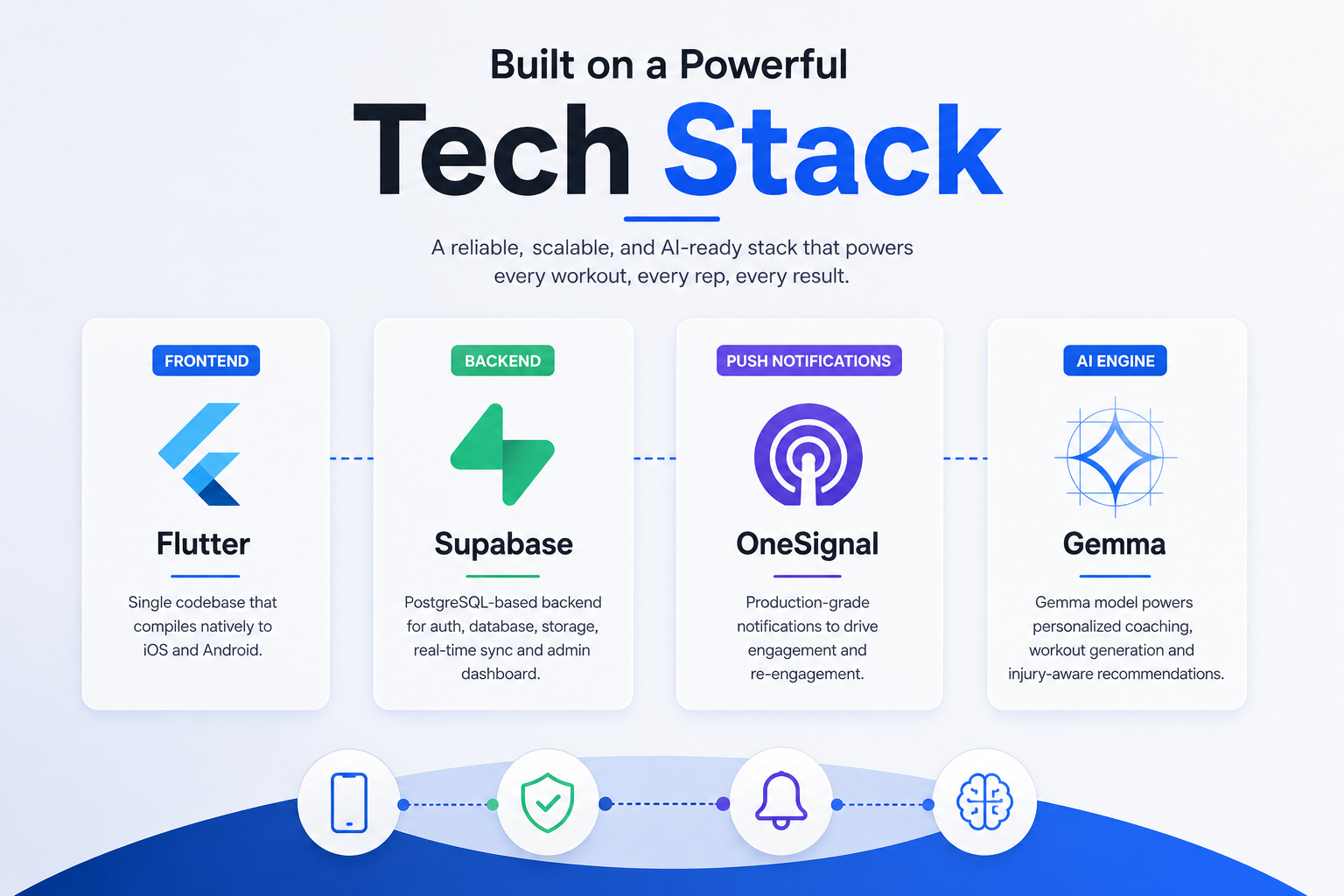
The tech stack behind a Freeletics clone script determines whether it scales past a demo. TrainBuddy AI runs on a stack chosen for speed of development and long-term reliability, which matters more for an AI gym coach app than most categories, since every AI-generated workout and coaching interaction adds real read/write load the moment users start engaging daily.
- Frontend: Flutter — a single codebase compiling natively to iOS and Android, so this AI fitness app script doesn't require two separate builds.
- Backend: Supabase — a PostgreSQL-based backend handling authentication, database, storage, and real-time sync, with a full admin dashboard included.
- Push Notifications: OneSignal — production-grade notification infrastructure already integrated for re-engagement.
- AI Engine: Gemma — the model powering personalized coaching, workout generation, and injury-aware recommendations.
4.1 Does This AI Gym Coach App Need a Separate Backend Purchase?
No. In this Freeletics source code, the backend isn't an afterthought or a separate add-on — Supabase handles user data, workout history, and admin controls natively, and the 14-screen admin dashboard covers subscriptions through AI usage monitoring out of the box.
4.2 Is the Freeletics Source Code Scalable for a Growing User Base?
Yes. Scalability is where cheaper AI fitness app script options fall apart — a lightweight local database or a backend with no real-time sync hits a wall fast. TrainBuddy AI's Supabase backend is built for growth, so the Freeletics clone app you start with on day one is the same architecture running at a hundred times the user base.
5. How Much Does a Freeletics Clone Script Cost to Buy?
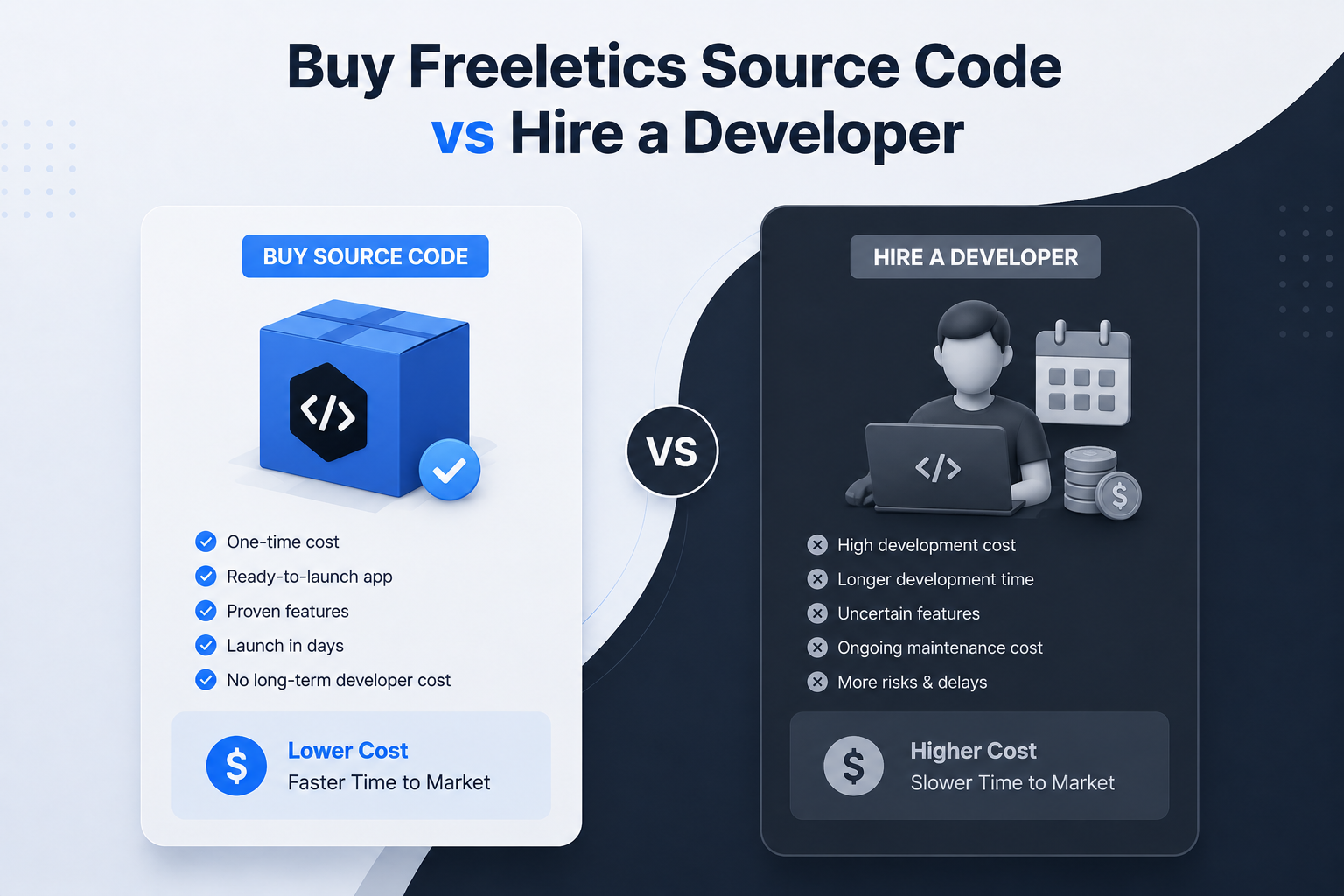
Hiring a team to build an AI personal trainer app from scratch typically starts well into five figures once you account for a Flutter developer, backend engineer, AI integration, and QA across both platforms — plus 8 to 12 weeks minimum, often longer once adaptive coaching logic is factored in.
A Freeletics clone script flips that cost structure. Instead of months of custom engineering, you pay once for working Freeletics source code and spend your budget on branding and launch instead. Buying TrainBuddy AI means paying for a finished, tested AI gym coach app instead of hourly development rates on a build that may not work as planned. For agencies quoting clients, this also means passing on real savings while still charging fairly for customization and branding work.
5.1 Is Buying Freeletics Source Code Cheaper Than Hiring a Developer?
Almost always. A freelance team charges for every hour of trial and error; a Freeletics clone app has already absorbed that cost. The code behind TrainBuddy AI's AI fitness app script is already built, debugged, and shipped — you're not paying to discover the bugs yourself. This purchase is typically a fraction of a custom build, with none of the scope-creep risk of managing a dev team directly, and most agencies still charge separately for AI integration on top of a custom base app. When you add up the true cost of an AI personal trainer app built from zero versus buying Freeletics source code outright, the gap usually isn't close.
6. How Fast Can You Launch an AI Gym Coach App From a Script?
Speed is the entire premise of buying Freeletics source code instead of building one. With TrainBuddy AI, the code is already written and functional — what's left is branding, configuration, and store submission.
For a founder with basic technical support, launching a rebranded Freeletics clone script typically takes days, not months. Swap the branding assets, connect your own Supabase project, configure your store listings, and you have a functioning AI personal trainer app live in the market — a sharp contrast to the 8-to-12-week timeline of a custom Freeletics clone app build.
6.1 Can a Non-Developer Launch a Freeletics Clone Script?
Yes. Non-developers can launch this AI gym coach app too — they just need a developer or agency for initial setup and store submission, days of work rather than months. Buying an AI fitness app script means the hardest 90% of the work — the AI engine, backend, and core logic — is already done before you start. Compared to hiring a team to build one from a blank file, purchasing ready-made Freeletics source code removes the single biggest bottleneck non-technical founders face.
7. What Makes TrainBuddy AI Different From Other Freeletics Clone Scripts?
Not every Freeletics clone script on the market is built the same way. Many are stripped-down UI kits sold as Freeletics source code but missing the actual coaching intelligence — no personality selection, no injury-aware logic, just a workout list with an AI label attached. TrainBuddy AI's difference is that every feature in this AI gym coach app ships wired and functional from day one, verified against a live 24-screen user app and 14-screen admin dashboard rather than a promised roadmap.
That distinction matters most once you're past the demo and into real users. A Freeletics clone app that only looks the part will start showing cracks the moment someone expects the AI to actually adjust their plan around an injury, a busy week, or a missed hydration goal. This AI personal trainer app was built with those real-world scenarios in mind, which is why founders comparing options consistently land on it over cheaper, thinner alternatives.
Price comparisons also tend to be misleading when they don't account for what's actually included. A bargain Freeletics clone script that ships without a real admin dashboard or subscription management will cost you again later, either in developer hours to build those pieces yourself or in lost revenue from a product you can't operate properly. TrainBuddy AI's Freeletics source code includes both from day one, which is a meaningful part of why it holds up as a genuine AI fitness app script rather than a partial one.
8. Is a Freeletics Clone Script the Right Move for You?
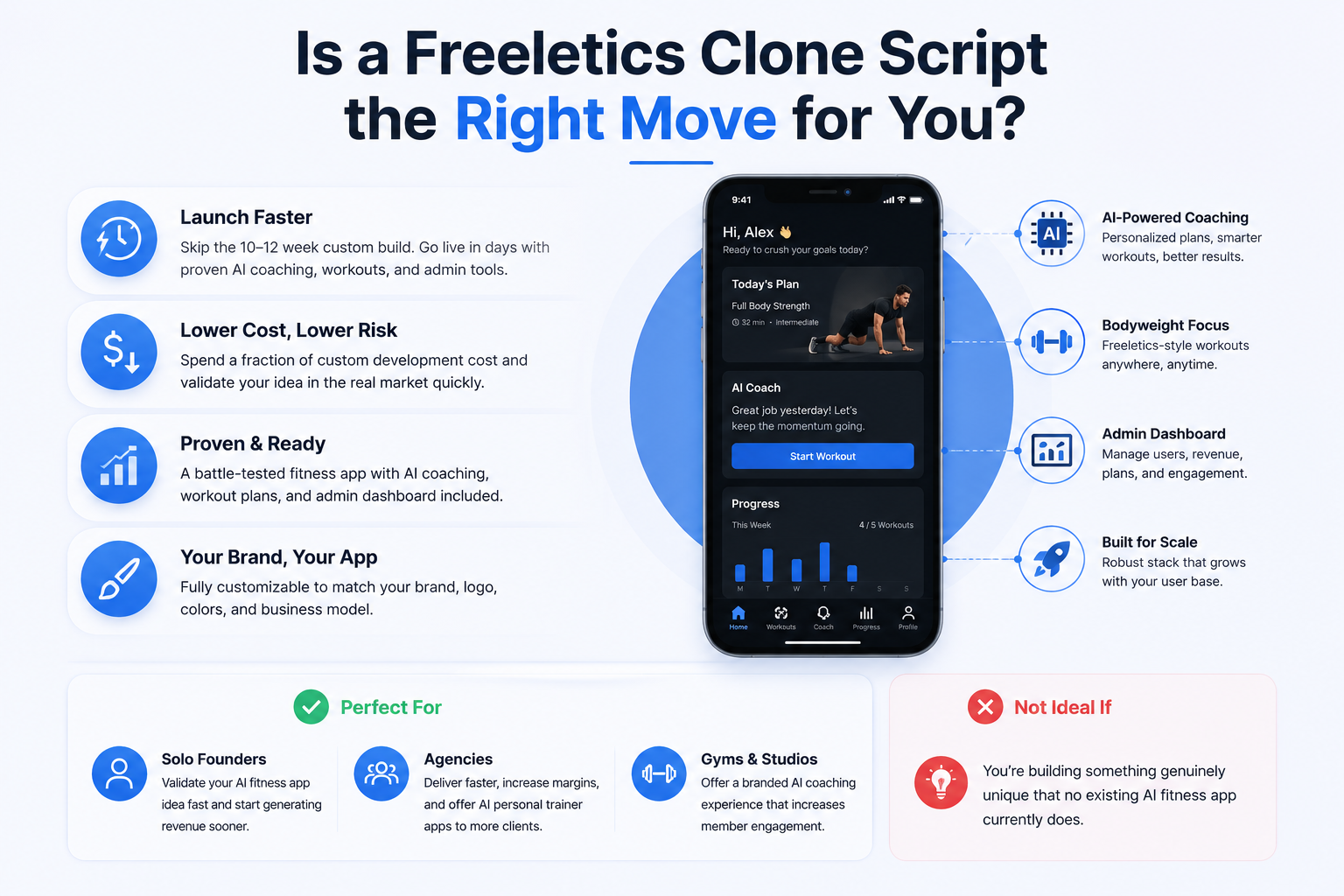
If your goal is to launch a bodyweight-friendly, AI-coached fitness app under your own brand quickly, a Freeletics clone script almost always beats a from-scratch build on time, cost, and risk. Buying Freeletics source code instead of hiring a team isn't a compromise — for most founders building a standard AI-coached fitness experience, it's the faster, cheaper, lower-risk path to an actual product.
Agencies benefit too — offering an AI personal trainer app like TrainBuddy AI as a starting point cuts delivery time dramatically while still allowing margin on customization and branding work, rather than quoting 10-12 weeks for a custom AI fitness app script build from zero. A gym or studio wanting to offer members a branded AI gym coach app gets the same benefit: the coaching engine and admin tools are already proven, so the only real work left is making the Freeletics clone app feel like an extension of their existing brand.
Solo founders exploring the fitness space for the first time also benefit from starting with Freeletics source code rather than a custom build. Validating demand for an AI fitness app script doesn't require committing tens of thousands of dollars and three months upfront — a Freeletics clone script lets you test positioning, pricing, and messaging in the real market within days, then decide whether deeper custom development is worth the investment. The only founders who should skip this Freeletics clone app route are those building something genuinely novel that no AI gym coach app on the market currently does.
9. FAQs
1. Does the Freeletics clone script come with documentation?
Yes. TrainBuddy AI ships with setup documentation covering the Freeletics source code, backend configuration, and rebranding steps, so you're not reverse-engineering the codebase on your own.
2. Can I use this AI personal trainer app for a niche fitness audience, or is it built for general fitness only?
Both. The coaching personality selection and injury-aware logic in this AI gym coach app adapt to different training styles, so it works as a general fitness product or as the base for a niche-focused Freeletics clone app — postpartum fitness, senior mobility, or sport-specific conditioning, for example.
3. Will the AI gym coach app receive future updates?
Arixlabs actively maintains the underlying AI fitness app script, and buyers get access to updates during their support window, with paid custom development available beyond that for deeper feature additions.
4. Can I resell an app I build from this Freeletics clone script?
Yes. Once you purchase the Freeletics source code, the resulting app is yours to publish, operate, and monetize as your own business — including reselling access via subscriptions to your own end users.
10. Ready to Launch Your Freeletics Clone App? Get TrainBuddy AI Today
Building an AI personal trainer app from scratch can take months and cost tens of thousands of dollars. TrainBuddy AI gives you the same result — a fully functioning AI gym coach app with adaptive, bodyweight-friendly coaching — in a fraction of the time, built on Flutter, Supabase, OneSignal, and Gemma. It's live now on the Arixlabs Marketplace, ready to rebrand and ship as your own Freeletics clone app.
Check out the TrainBuddy AI Template on the Arixlabs Marketplace → https://www.arixlabs.com/marketplace/trainbuddy-ai---ai-fitness-coach
%20(1).jpg)

View more blogs



.png)
.png)
%20(1).png)
.png)
Ready to develop your own product? Get in touch today!
Get in Touch