



1. Introduction
Anyone can put "Cursor expert" on a resume. Very few can actually ship production code with it, which is why so many US teams end up disappointed weeks into a contract. Cursor rewards people who already understand software architecture, not people relying on it to write architecture for them. If you're trying to hire Cursor developers in the USA, the real skill you're screening for is judgment, not prompt phrasing, and that judgment is what separates a good hire Cursor developers in the USA search from a wasted one.
Arixlabs (previously FlutterFlowDevs) works with founders and product teams across the US who need builders that can move fast without leaving a mess behind. Alongside FlutterFlow and Supabase work, Arixlabs now runs a dedicated Claude Code vibe coding service, which means the team already lives inside the exact workflow this blog is about: AI-assisted, agentic coding tools used by people who know what good code looks like before the tool ever suggests it. If you want to hire a Cursor expert in the USA without spending a month vetting candidates yourself, this is the kind of team built for that job. Here's what to actually look for.
Most guides treat every candidate the same, but the market for a Cursor AI developer for hire in the USA splits into two pools: people who've used the tool casually, and people who've shipped real, revenue-generating products with it. This blog helps teams tell those pools apart before signing a contract, not after, whether you plan to hire a Cursor expert in the USA directly or through an agency.
2. Where should you go to hire a Cursor developer when you're shipping in the US?
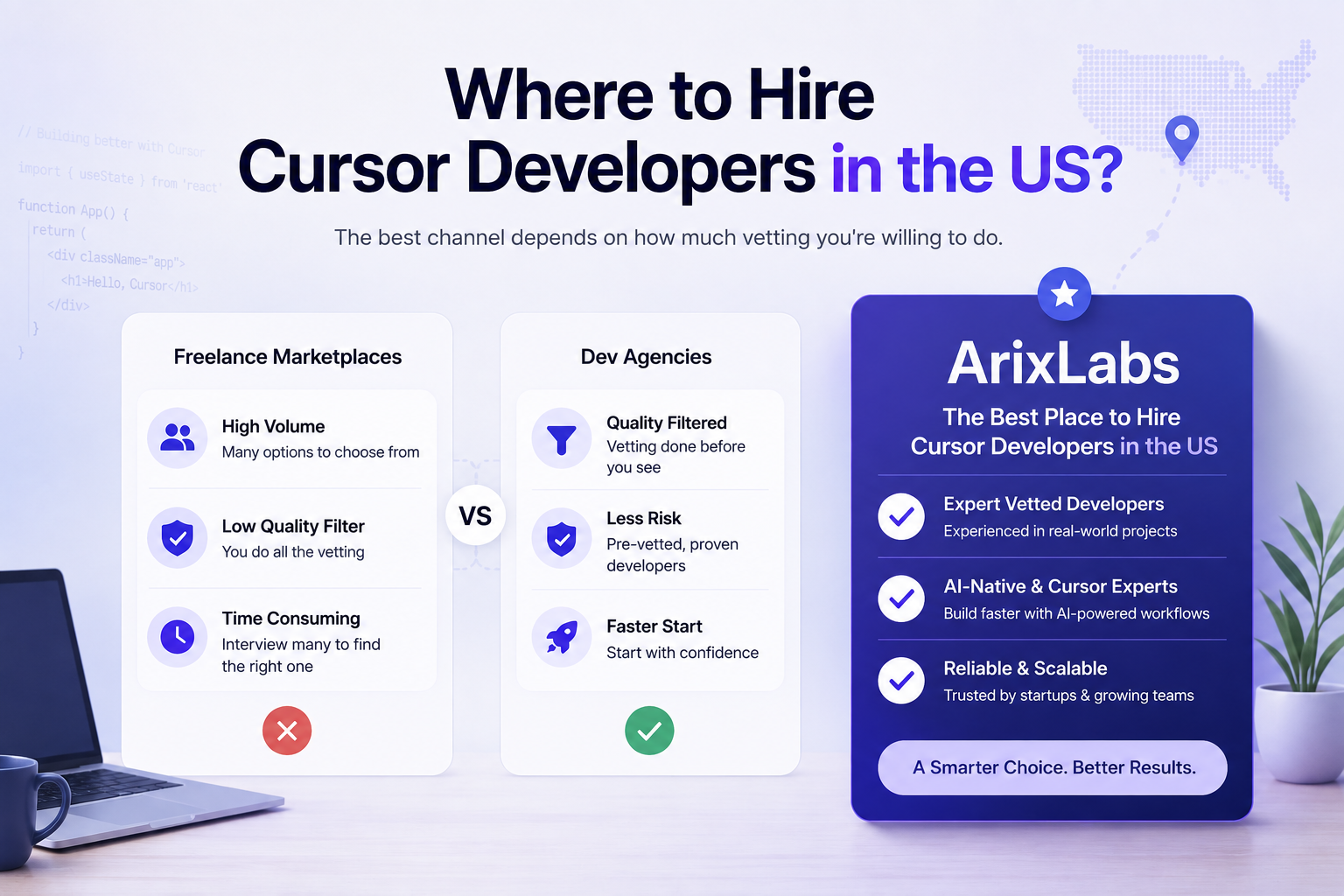
The best channel depends on how much vetting you're willing to do yourself. General freelance marketplaces give volume but little quality filter, so you'll interview a dozen people before finding one who can hold a real conversation about state management or API design. Specialized dev agencies give you less volume but far less risk, because the filtering already happened before you ever saw a candidate. This is why serious teams choose to hire Cursor developers in the USA through an agency rather than a marketplace, and it's also why so many of them come back to hire Cursor developers in the USA again for a second project.
Working with a remote Cursor developer is the default now, not the exception, since a Cursor AI developer for hire in the USA rarely sits in the same building as the team. A Cursor AI developer for hire in the USA working from the same coast as your team, or an offshore team with a few overlapping hours, both work fine as long as async handoffs are clean and code reviews happen daily. What breaks projects isn't distance, it's a lack of a shared process for reviewing what the AI-assisted code actually did.
2.1 How fast can a Cursor developer get started, if you're shipping in the US?
With a proper agency, onboarding usually takes a few days: repo access, a short architecture walkthrough, and one small task to confirm they understand your codebase conventions before anything bigger lands. Arixlabs runs new engagements this way specifically so a Cursor AI developer for hire in the USA isn't guessing at your standards on day one.
Referrals help too. If another founder in your network has already gone through the process to hire Cursor developers in the USA, ask them directly who they used and what broke down along the way. A five-minute conversation with someone who's already paid for a bad hire will save you far more time than another round of resume screening. It's also usually the fastest way to find a Cursor AI developer for hire in the USA who's already been quietly vetted by someone you trust.
3. What should a Cursor developer already know when you're shipping in the US?
A capable candidate should be comfortable reading and refactoring code they didn't write, not just generating new files from a prompt, since anyone who wants to hire Cursor developers in the USA needs someone who understands version control discipline, can break a large feature into reviewable pull requests, and can explain why the AI suggested a particular approach instead of blindly accepting it. This is the difference between someone who happens to hire Cursor developers in the USA for their team and someone who actually knows how to manage the output, and it's usually obvious within the first week of working together.
3.1 What's the smartest way to test a Cursor coder's skills, if you're shipping in the US?
Give them a real bug from your codebase, not a toy problem. Watch how they use Cursor: do they read the surrounding code first, or do they immediately prompt for a fix? Good engineers use the tool to accelerate understanding. Weak ones use it to skip understanding entirely, and that shows up fast once you ask a follow-up question about the fix.
3.2 What things should you ask a Cursor coder, if you're shipping in the US?
Ask how they handle a Cursor suggestion that looks right but breaks a test. Ask how they structure prompts for a multi-file change. Ask what they do when the model hallucinates an API that doesn't exist. Their answers tell you more than any portfolio link. Anyone can claim to be a Cursor AI developer for hire in the USA, but only someone with real reps can answer these cleanly.
It also helps to ask about failure, not just success. A developer who can walk you through a time Cursor led them down the wrong path, and how they caught it, is almost always a safer choice than one who claims the tool has never once given them a bad suggestion. That kind of honesty is a strong signal when you're trying to hire a Cursor expert in the USA for anything beyond a throwaway prototype.

4. Should you hire a Cursor expert or an all-rounder when you're shipping in the US?
This depends on the shape of your roadmap. Building one core product on a stable stack, a generalist who's picked up Cursor is often enough, and you may not need to hire a Cursor expert in the USA at all. If your team is moving fast across multiple AI-assisted workflows, agentic coding, automated testing, rapid prototyping, it's worth it to hire a Cursor expert in the USA who's spent real hours inside the tool's quirks: context window limits, when to break a task into smaller prompts, and when Cursor is the wrong tool for the job entirely, which is exactly why some founders choose to hire a Cursor expert in the USA even for a fairly small project.
4.1 What should a Cursor engineer cost, if you're shipping in the US?
Rates vary widely by experience and engagement type, but as a rough guide, specialists typically charge more per hour than generalist developers because they ship faster and produce fewer review cycles. The math often works out in the client's favor even at a higher rate, since less time gets burned on rework. Arixlabs prices engagements around outcomes rather than hours wherever possible, which is one reason teams come back after their first project to hire Cursor developers in the USA again for the next one.
This is also where the expert-versus-generalist decision usually gets decided in practice. A team with a single, well-understood codebase can often lean on a generalist and save the premium that comes with hiring a specialist. A team juggling several AI-assisted workflows at once, or one that's had a bad experience with unreviewed AI output before, tends to find it worth paying more to hire a Cursor expert in the USA who won't need hand-holding on tool-specific quirks.
5. Cursor coders vs general vibe coding engineers for US teams
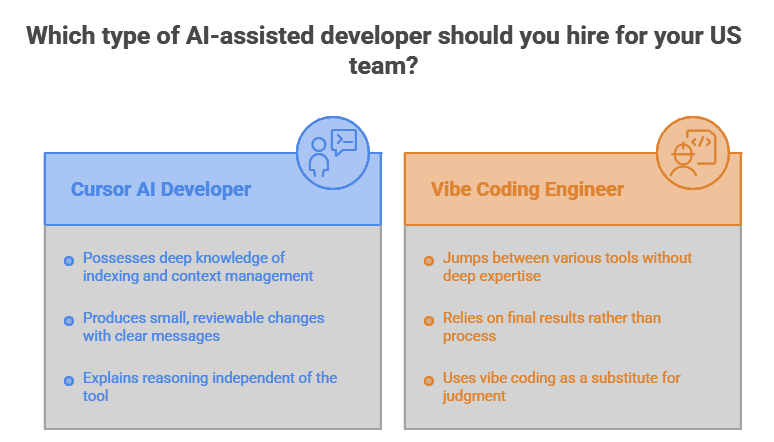
"Vibe coding" is a catch-all term, worth separating out. A general vibe coding engineer jumps between Cursor, Replit, Claude Code, and other tools without deep mastery of any one, unlike a proper Cursor AI developer for hire in the USA, who knows the tool's specific behavior: how its indexing works, how to keep context tight across a large repo, and how to avoid subtle bugs from accepting suggestions without reading them closely.
Checking over Cursor project samples in the US is the fastest way to tell the two apart. Ask for a repo, not a screenshot. Look at commit history, not just the final result. A real Cursor AI developer for hire in the USA will have a commit trail that shows iteration: small, reviewable changes, clear messages, and evidence of manual correction where the AI got something wrong. Screenshots of a working app tell you nothing about how the code got there.
Arixlabs leans toward specialists precisely because of this gap. When a team wants to hire Cursor developers in the USA for a serious build, not a weekend prototype, tool-specific depth consistently outperforms broad, shallow familiarity across five different AI coding tools, and it's the standard Arixlabs holds every hire Cursor developers in the USA engagement to.
There's nothing wrong with a generalist who's good at their job. The problem shows up when "vibe coding experience" is used as a substitute for actual engineering judgment. A genuine Cursor AI developer for hire in the USA should be able to explain their reasoning independent of the tool, because the tool is only ever as good as the person directing it.
6. Common Cursor workflow mistakes to screen for in US-based hires
The top mistake is accepting large multi-file suggestions without reading them line by line, something every Cursor AI developer for hire in the USA should be trained out of early. The second is prompting for a whole feature at once instead of small, testable steps. The third, and probably the most expensive one, is skipping tests because "the AI usually gets it right." Cursor is excellent at pattern-matching to what similar code usually looks like, which is exactly why it's dangerous on code paths that are unusual on purpose, like custom business logic or edge-case handling.
6.1 Would it be hard to find a capable Cursor engineer, if you're shipping in the US?
It's harder than it should be, mostly because the market is flooded with people who've used the tool casually but haven't built anything production-grade with it. Filtering for real experience is the entire job of a good vetting process, and it's exactly why agencies exist for teams that don't have time to run that filter themselves before they hire Cursor developers in the USA.
If your goal is simply to hire a Cursor expert in the USA and move on with building, the fastest path is working with a team that already screens for these mistakes before a candidate ever reaches your interview.
Another mistake worth flagging: treating every task as equally suited to AI assistance. Cursor is excellent for scaffolding, refactors, and repetitive patterns, but it's a poor substitute for careful thinking on genuinely novel problems. Teams that want to hire Cursor developers in the USA for their most sensitive systems should expect their developer to know exactly where that line sits, and to say so unprompted.
7. Cursor developers, remote work, and US-based teams
7.1 When you're shipping in the US, should I need a Cursor specialist for my job?
Not always, but for anything beyond a simple internal tool, the answer leans yes. Complex frontends, real-time features, or anything touching payments or auth benefit from someone who's already seen where Cursor tends to go wrong in those exact scenarios. If you're unsure which side of that line your project falls on, it's worth a short call before you commit to hiring anyone. Most teams that eventually decide to hire a Cursor expert in the USA started out assuming a generalist would be fine, then changed their mind once the project's real complexity became clear.
7.2 How fast can a Cursor engineer build a prototype, if you're shipping in the US?
A skilled Cursor AI developer for hire in the USA can often turn around a working prototype in a matter of days rather than weeks, precisely because the tool removes so much boilerplate. The speed only holds up if the person driving it understands what "done" actually means for your use case, not just what compiles, which is why the fastest Cursor AI developer for hire in the USA isn't always the best one.
Arixlabs has built this exact workflow into its Claude Code vibe coding service: fast prototyping backed by engineers who know when to slow down and review. Teams that want to hire Cursor developers in the USA for both speed and reliability tend to find that combination hard to get anywhere else.
Remote arrangements work best when expectations are set early: daily standups, a shared review process, and clear ownership of what "done" looks like for each ticket. A dependable Cursor AI developer for hire in the USA will suggest this structure themselves rather than waiting to be asked, because they've likely seen what happens on projects that skip it, and skipping it is one of the fastest ways to regret a decision to hire a Cursor expert in the USA.
None of this is complicated once the right person is in the seat. The whole point of trying to hire a Cursor expert in the USA in the first place is to remove the guesswork around speed and quality at the same time, instead of trading one for the other.
8. FAQ
1. Roughly how much would Cursor coders charge, if you're shipping in the US?
Rates typically range based on seniority and project complexity, with specialists generally priced above generalist developers. Project-based pricing is common for well-scoped work, while hourly billing suits ongoing or exploratory engagements. Whatever the structure, most founders comparing quotes to hire a Cursor expert in the USA find it worth weighing total delivery time, not just the hourly number.
2. What platforms list Cursor experts for hire in the US?
General freelance marketplaces list the highest volume of candidates, but specialized agencies like Arixlabs typically offer the strongest pre-vetted pool for teams that want to skip the screening process themselves and simply hire a Cursor expert in the USA with confidence.
3. Can Cursor developers work under NDA?
Yes. Most professional Cursor developers, including the team at Arixlabs, routinely sign NDAs before any code or product details are shared, and this is standard practice for anyone looking to hire Cursor developers in the USA on a serious, IP-sensitive build.
4. Do Cursor development agencies charge by hour or by project?
Both models exist. Agencies often prefer project-based pricing for well-defined scopes and hourly billing for ongoing or open-ended work, and a good agency will recommend whichever model fits your specific build before you commit to hiring a Cursor AI developer for hire in the USA.
9. Conclusion
Teams that want to hire Cursor developers in the USA without burning weeks on vetting have a straightforward option: work with a team that's already inside this workflow every day. Arixlabs combines its FlutterFlow and Supabase production experience with a dedicated Claude Code vibe coding service, giving US founders a single place to hire a Cursor expert in the USA who understands both the tool and the product it's building. For any team still comparing options, the fastest way to hire a Cursor expert in the USA is simply to start the conversation with a team that already builds this way every day, and a Cursor AI developer for hire in the USA from Arixlabs is exactly that kind of starting point.
%20(1).jpg)

View more blogs



.png)



.png)
Ready to develop your own product? Get in touch today!
Get in Touch