



Introduction
A Lovable project rarely stays a side experiment for long. Once real users start signing up and using it daily, the request that comes up again and again is simple: "can I get this on my phone?" That question marks the point where building mobile app from Lovable stops being optional and starts being the next real milestone for the product. This isn't about scrapping what's already working. It's about carrying the product you've built into a format phones actually support natively. Arixlabs (previously FlutterFlowDevs) works specifically in this space, taking existing Lovable projects and turning them into fully functional native applications rather than starting the engineering from zero. This blog breaks down exactly what carries over from a Lovable project into native app form, what has to be rebuilt, and what a realistic build actually involves.
1. How do you build mobile from a Lovable project?
Building mobile app from Lovable starts with treating the existing project as a specification, not a starting draft to be discarded. The first real step is a technical audit: cataloguing every screen, every database table, every integration, and every user flow that already exists. From there, the team decides what layer needs a full rebuild versus what layer can be connected directly. In most cases, the backend and business rules stay largely intact, while the frontend gets rebuilt in a framework designed for native performance. Arixlabs typically runs this audit before quoting any timeline, because the actual scope of a Lovable project native application depends entirely on how much custom logic already exists, not just how many screens the product has.
2. What parts of Lovable can be reused for mobile?
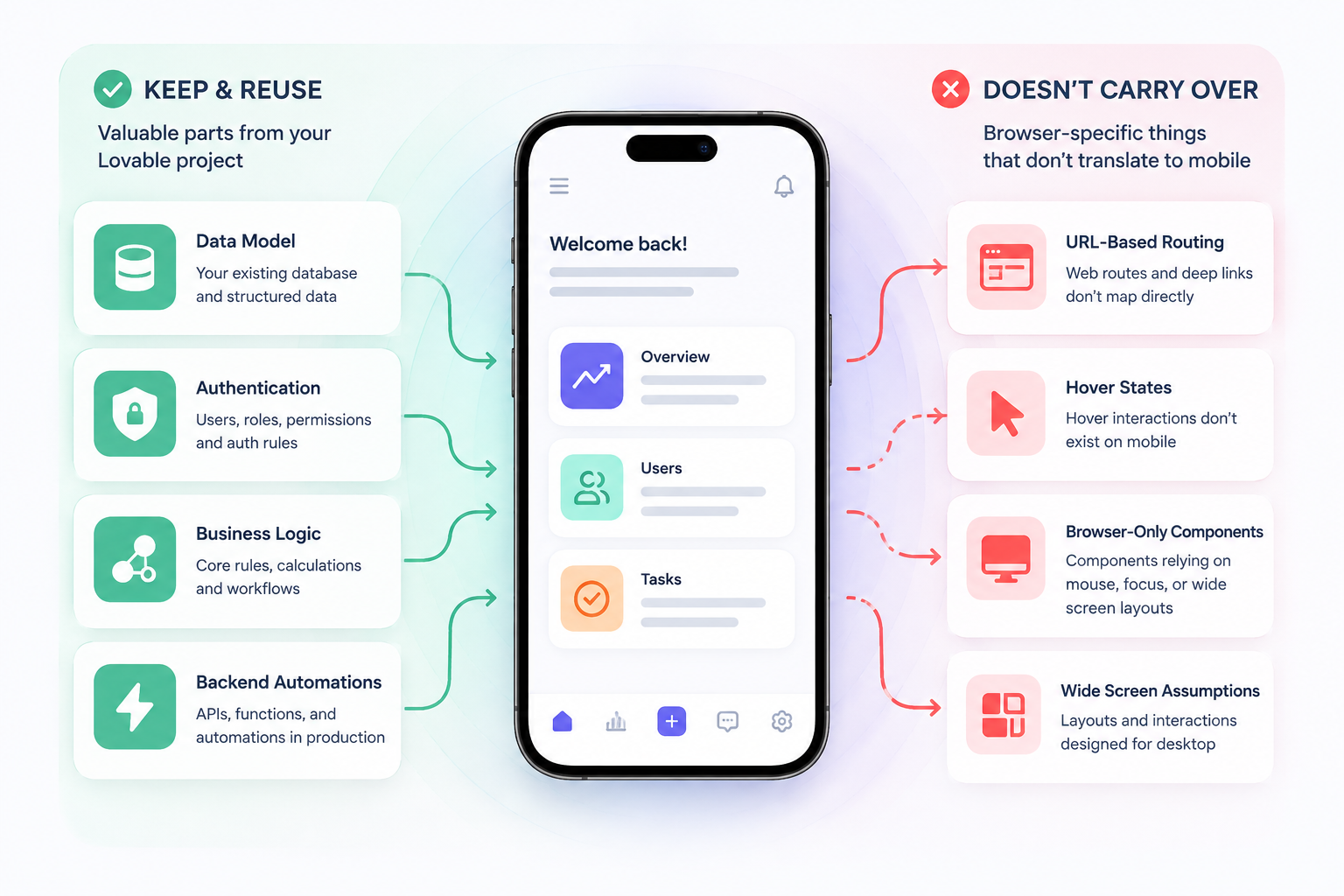
The parts worth protecting in any rebuild Lovable project for mobile effort are the parts that took the most thought to get right the first time: the data model, the authentication rules, the business logic, and any backend automations already running in production. None of that needs to be rewritten from scratch just because the delivery format is changing. What typically doesn't carry over cleanly is anything tied to browser-specific behavior, like URL-based routing, hover states, or components that assume a mouse and a wide screen. Arixlabs separates these two layers early in the process so the reusable logic isn't accidentally rebuilt, and the browser-only pieces aren't dragged along where they don't belong.
2.1 Can the Lovable database connect to mobile?
Yes. A Lovable backend running on Supabase or a comparable service can serve both a web app and a native mobile app at the same time, through the same tables and rules. The mobile app simply talks to that backend through its own API layer rather than needing a separate database.
2.2 How can Lovable APIs support a mobile app?
Any APIs already built for the Lovable project, whether custom endpoints or third-party integrations, can generally be called from a native app the same way they're called from the web version. The native app just needs its own authentication handling and request structure to talk to those same endpoints securely.
3. How can Lovable project become a production mobile app?
Turning a Lovable build into a genuine production mobile app means going past a working prototype and building something stable enough for real daily use, app store review, and ongoing updates. This involves proper error handling, offline behavior, performance optimization for real devices instead of a browser preview, and a build process that supports future updates without breaking existing users. A Lovable code for mobile app project that skips this step tends to work fine in a demo and then falls apart the moment real users with slow connections or older devices start using it. Arixlabs treats production-readiness as a checklist, not an afterthought, covering crash reporting, analytics, and update pipelines before a build ever reaches app store submission.
3.1 What frontend changes does Lovable web app need for mobile?
The frontend generally needs a full rebuild in a native-capable framework, since Lovable's web output isn't designed to compile into an iOS or Android binary. This means redesigning layouts for touch and smaller screens, and rebuilding interactive components using native UI patterns instead of web components.
4. What is needed to rebuild Lovable project for iOS and Android?
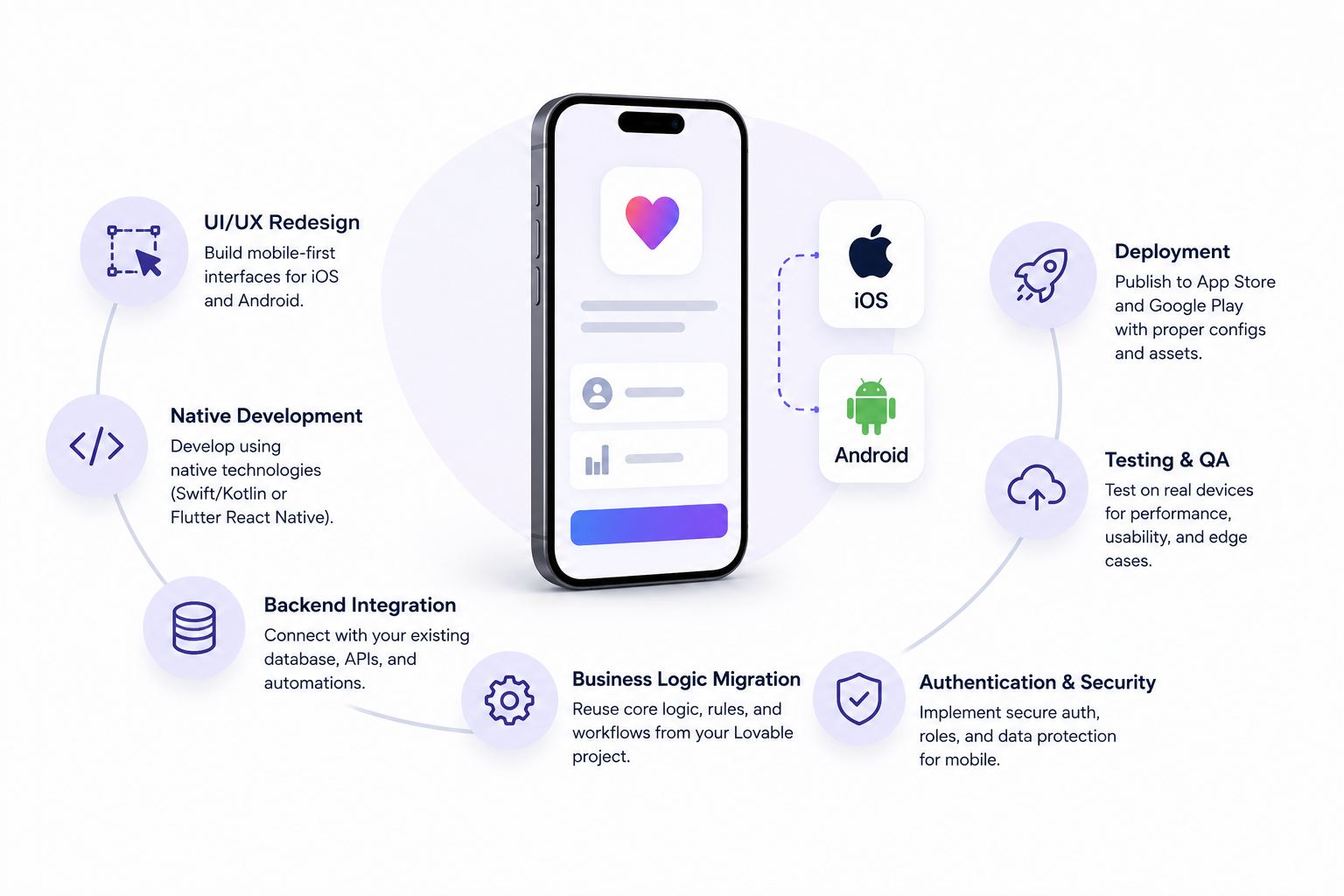
A proper rebuild needs four things in place before development starts: a completed audit of the existing Lovable project, a clear map of which backend services will be reused, a native framework decision, and a design pass specifically for mobile screen sizes and gestures. Flutter is the framework Arixlabs uses most often here, since it produces one codebase that compiles natively to both iOS and Android, avoiding the cost of maintaining two separate native builds. This matters directly for Lovable project into native app timelines, since a shared codebase cuts development time roughly in half compared to building separate Swift and Kotlin apps from scratch.
4.1 How should Lovable navigation work on mobile?
Web navigation built around URLs and browser history doesn't translate directly to mobile. Native apps need navigation stacks, tab bars, or bottom sheets designed specifically for touch interaction, which means navigation is one of the areas that gets rebuilt rather than ported.
4.2 Which Lovable features need to be rebuilt?
Anything relying on browser-specific behavior, like hover-triggered menus, drag-and-drop built for a mouse, or components that assume unlimited screen width, needs to be rebuilt for touch and smaller viewports. Core business features like dashboards, forms, and data views usually just need a native redesign rather than new logic.
5. Can a Lovable project become a native application?
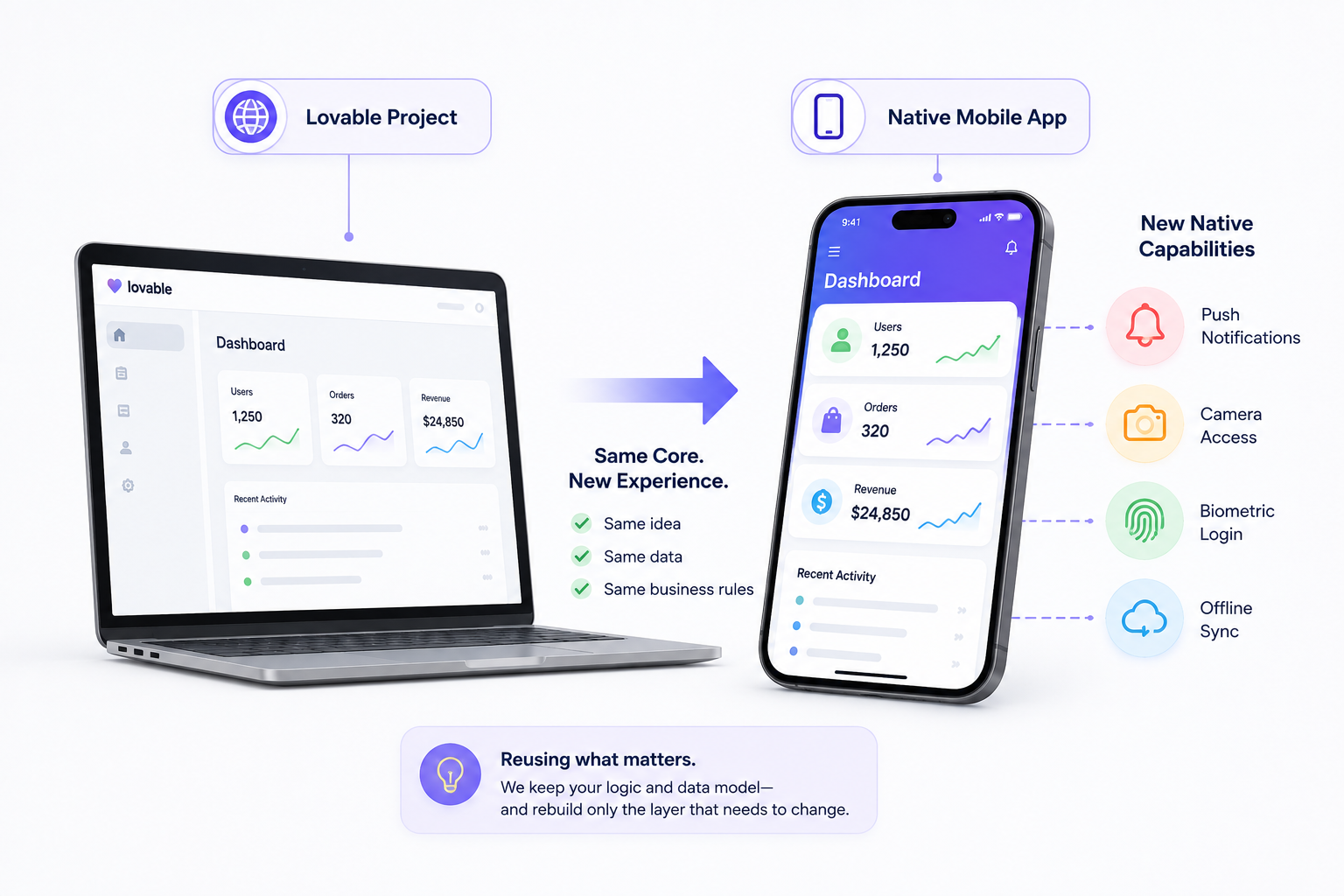
Yes, and this is the core premise behind every Lovable project native application Arixlabs has delivered. The product idea, the data structure, and the business rules don't need to change just because the delivery format does. What changes is how the interface is built and how the app talks to device-level features like push notifications, camera access, and biometric login. Founders sometimes worry that going native means losing months of Lovable development work. In practice, a well-scoped rebuild reuses the majority of that thinking and only rebuilds the layer that has to change.
6. How are Lovable-generated apps developed for mobile?
The development process for Lovable-generated apps typically runs through five phases: audit and technical scoping, native UI/UX design, native development in Flutter or an equivalent framework, backend integration and testing, and finally store preparation. Each phase produces something tangible before the next one starts, which keeps the project measurable instead of open-ended. Arixlabs runs this as a structured pipeline with checkpoints at each phase, so founders see working builds early rather than waiting months for a single reveal at the end.
Frequently Asked Questions
1. Do I need to rebuild Lovable from scratch?
No. The backend logic, data structure, and business rules from your Lovable project can generally be reused; only the frontend needs a full native rebuild.
2. Can a developer build mobile from my Lovable project?
Yes, a developer experienced in native frameworks like Flutter can take an existing Lovable project and rebuild it as a native iOS and Android app.
3. Can Lovable support both web and mobile?
Yes, the same backend can serve a Lovable web app and a separately built native mobile app simultaneously, since both connect through the same data layer.
4. Which technology can turn Lovable into mobile?
Flutter is the most common choice, since it compiles one codebase into native iOS and Android apps, avoiding the need to build and maintain two separate native versions.
%20(1).jpg)

View more blogs
.png)
.png)

.png)

.png)

.png)
_b_change__2025__to__20.jpg)
Ready to develop your own product? Get in touch today!
Get in Touch