


.png)


1. Introduction
Getting a vibe coding project estimate in the USA should feel simple. It rarely does. Here's what founders and product teams run into when they try to get a vibe coding quote in the USA:
- Two firms quote the same scope and land $15,000 apart, with no explanation why.
- A "fixed" number turns into a moving target once development starts.
- Proposals read like sales pitches instead of engineering plans.
- Teams sign a fixed-price vibe coding project without knowing what's actually included.
The difference usually comes down to experience. While many agencies now use AI-assisted development tools, not every team has the expertise to turn AI-generated code into production-ready software.
At ArixLabs, we've delivered vibe coding projects for startups and enterprises across a range of industries, helping founders move from idea to launch with speed while maintaining the engineering quality needed for real-world applications. That hands-on experience has given us a clear understanding of how accurate project estimates are built, what factors genuinely influence pricing, and where projects often exceed budget. The insights in this guide are based on those real-world delivery experiences, helping you understand what separates a reliable vibe coding estimate from one that's likely to change once development begins.
2. When you're shipping in the US, what do you need to think about before you provide to get an accurate vibe coding quote?
Before you ask anyone to get a vibe coding quote in USA, define your scope, your must-haves, and your timeline. A vague brief is the single biggest reason estimates go sideways later, because every provider fills in the gaps differently.
Start with three things: what the app needs to do on day one, which integrations are non-negotiable, and how fast you need to launch. If you're aiming for a fixed price vibe coding project in the USA, this clarity matters even more, since fixed pricing depends entirely on locked scope. Vague requirements force providers to either overestimate for safety or underestimate to win the deal.
Also decide upfront whether you need ongoing support after launch. A vibe coding project estimate in the USA that only covers the build, and not testing, deployment, or post-launch fixes, will look cheaper on paper but cost more in practice. Teams that skip this step often end up comparing numbers that were never measuring the same work.
3. When you're shipping in the US, why do vibe coding quotes vary between firms?
Quotes vary because "vibe coding" isn't a single defined service, it's a spectrum of tooling, oversight, and code quality. Two firms can use the same AI-assisted platform and still deliver very different outcomes.
The biggest swing factor is how much human review sits on top of the AI-generated code. A vibe coding project estimate in the USA from a team that manually audits logic, security, and data handling will cost more than one that ships raw AI output with light checks. Neither is automatically wrong, but they're not the same product.
Team seniority, US-based support hours, and infrastructure choices also move the number. A firm quoting a fixed price vibe coding project in the USA with senior engineers reviewing architecture decisions is pricing in risk reduction you won't see in a bare-bones quote. When you get a vibe coding quote in USA, ask what's driving the number, not just what the number is.

3.1 When you're shipping in the US, fixed estimate vs rough estimate for vibe coding
Is a rough estimate the same as a fixed quote? No. A rough estimate is a range based on limited scope discussion, useful early on but not something to build a budget around. A fixed price vibe coding project in the USA means the scope, deliverables, and cost are locked, with changes handled through a separate change order process. If a provider gives you a firm number after a 10-minute call, that's usually still a rough estimate wearing a fixed-price label.
4. When you're shipping in the US, what's usually included in a vibe coding estimate?
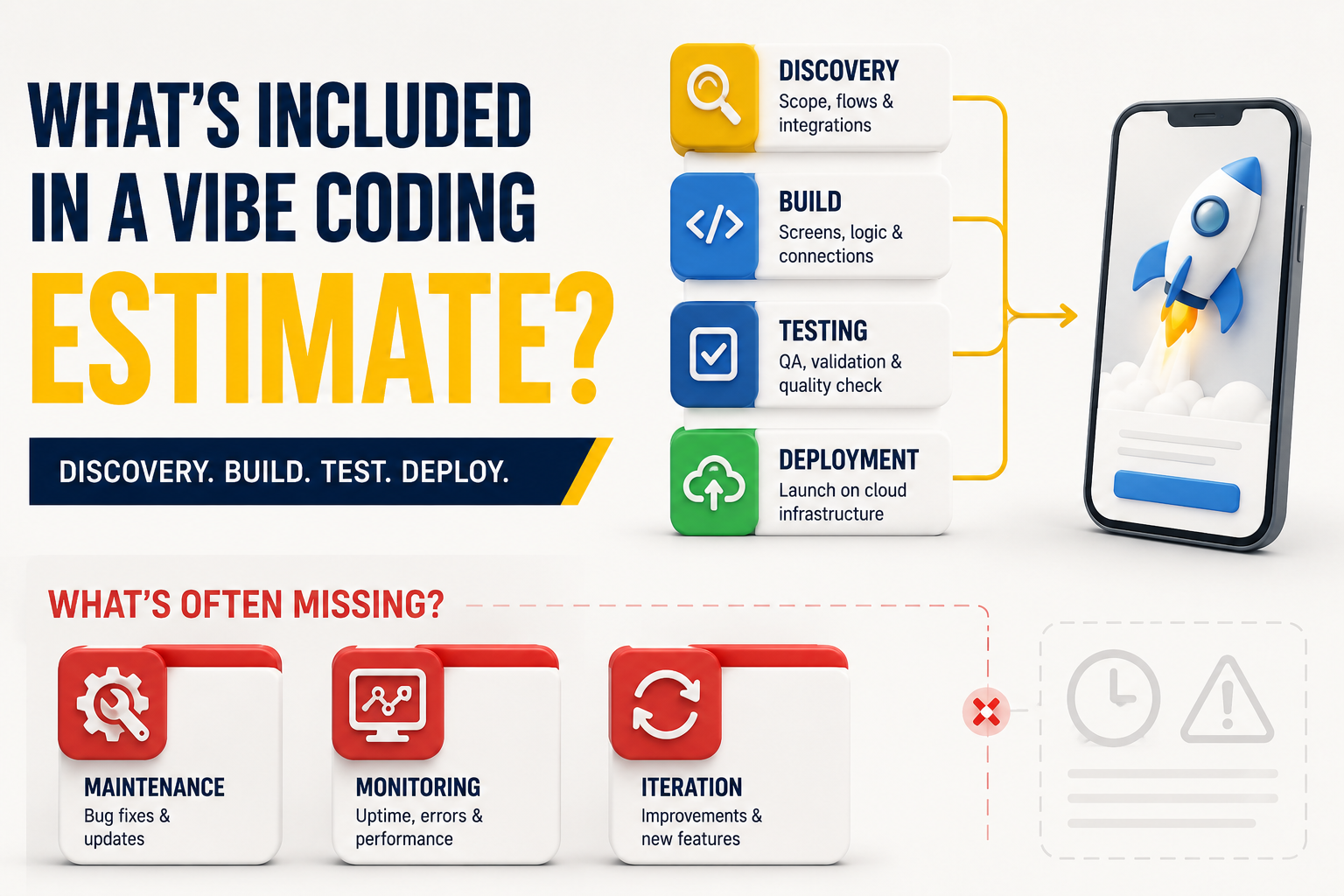
A solid vibe coding project estimate in the USA typically covers discovery, development, testing, and deployment at a minimum. Discovery includes defining the app's core flows, understanding requirements, and identifying any third-party integrations needed for the build.
Development costs usually reflect the number of screens, feature complexity, custom logic, and backend requirements involved. Testing should be listed as its own stage, not treated as an afterthought, since AI-assisted development still requires human review, quality checks, and debugging before the product reaches real users. Deployment covers preparing the application for launch, configuring the required environment, and making sure the final product is ready for production use.
What's often missing from vibe coding estimates?
Post-launch maintenance, monitoring, and iteration cycles are frequently left out entirely. This is one reason Arixlabs treats these as visible line items rather than folding them into vague "support included" language, so clients see exactly what a fixed price vibe coding project in the USA actually pays for before they sign anything.
5. What's the right approach to size up quotes from different vibe coding providers, if you're shipping in the US?
Compare scope before you compare price. Two proposals with the same dollar figure can represent wildly different amounts of actual engineering work, so line up deliverables side by side first.
Look specifically at what each provider includes for testing, security review, and post-launch support. A vibe coding project estimate in the USA that skips these will almost always look cheaper upfront and cost more later through rework or downtime. Ask each provider to break their number into phases: discovery, build, QA, deployment, so you're comparing apples to apples.
5.1 Comparing multiple vibe coding quotes, if you're shipping in the US
How many quotes should I collect before deciding?
Three is typically enough to see a realistic price range without dragging out the decision. Fewer than that and you risk anchoring to one number; more than that and the comparison gets harder to manage. When you get a vibe coding quote in USA from each, ask the same scoping questions so the comparison stays fair.
6. What things should you ask before accepting a vibe coding estimate, if you're shipping in the US?
Ask who reviews the AI-generated code before it ships, and what that review process looks like. This single question often separates experienced vibe coding providers from teams that simply rely on AI output without proper engineering oversight.
Ask what happens if the project scope changes mid-development, and how those changes affect a fixed-price vibe coding project in the USA. A clear process for handling revisions and additional requirements is usually a sign that the provider understands how real projects evolve.
Ask about testing, security practices, and quality checks as well. AI-assisted development can speed up production, but every application still needs proper validation to identify bugs, performance issues, and potential security risks before launch.
Finally, ask for references or examples of previous work. A provider confident in their vibe coding project estimates should be able to demonstrate successful builds and explain how they approach delivery. At ArixLabs, our experience delivering production-ready vibe coding projects means these conversations are based on real development processes, from initial estimates through launch and ongoing improvements.
7. How detailed should a vibe coding proposal be, if you're shipping in the US?
Detailed enough that you could hand it to a different developer and they'd understand exactly what's being built. Vague proposals are a warning sign, not a convenience.
A strong vibe coding project estimate in the USA breaks down each phase, lists specific deliverables, and states what's explicitly out of scope. Vagueness here almost always turns into scope disputes later, especially on a fixed price vibe coding project in the USA where every addition needs a change order.
8. What counts as a red flag in a vibe coding quote, if you're shipping in the US?
Watch for numbers that are dramatically lower than every other quote you've collected, with no explanation for the gap. A vibe coding project estimate in the USA priced far below market usually means corners are being cut somewhere, often in testing or security review.
Vague scope language is another red flag. Phrases like "full app build" with no breakdown of screens, features, or integrations leave too much room for disputes later. Same goes for a fixed price vibe coding project in the USA that doesn't define what counts as a change versus what's included.
8.1 Negotiating a vibe coding build quote, if you're shipping in the US
Can I negotiate a vibe coding quote?
Yes, but negotiate scope and payment structure rather than just asking for a flat discount. Ask if phased payments tied to milestones are possible, or if certain features can move to a second phase to bring the initial number down without cutting quality on the core build.
9. FAQ
1. How do I get an accurate vibe coding estimate, if you're shipping in the US?
Provide a clear scope, specific integrations, and a realistic timeline before you ask anyone to quote. The more defined your brief, the more accurate the number will be.
2. Why do vibe coding quotes differ so much, if you're shipping in the US?
Because providers vary in how much human review, testing, and infrastructure work sits behind the AI-generated code, and that difference shows up directly in price.
3. When you're shipping in the US, is a low vibe coding estimate a red flag?
Often, yes. A number well below the market range usually means testing, security review, or post-launch support has been stripped out of the quote.
4. What should I ask before signing a vibe coding pitch, if you're shipping in the US?
Ask about code review process, change-order terms, data security practices, and what's included after launch. If any answer is vague, treat that as a warning sign.
%20(1).jpg)

.png)
.png)

_b_change__2025__to__20.jpg)
.png)
.png)

Ready to develop your own product? Get in touch today!
Get in Touch