

.png)


1. Introduction
Base44 gets an idea into real users' hands fast. What it does not do is turn that idea into an installed, native app on the App Store and Google Play, and that is exactly the gap ArixLabs exists to close. As a dedicated Base44 mobile app development company, ArixLabs (previously FlutterFlowDevs) takes founders from a validated Base44 build to a production-grade native app without losing the logic and traction the original product already earned. This guide walks through how ArixLabs actually runs a Base44 native application services engagement from first audit to store submission, and why founders comparing options keep landing on the same answer, whether they started their search looking for a Base44 app development agency or simply Base44 mobile developers for hire with real Base44 experience.
Whether a founder is searching for a Base44 app development agency, browsing Base44 mobile developers for hire, or scoping a full Base44 production mobile development project, the evaluation usually comes down to the same handful of questions: has this team done it before, do they understand Base44's architecture specifically, and can they show a repeatable process rather than a one-off experiment. These same evaluation questions apply just as much when the search term is Base44 native application services or simply professional Base44 app development. ArixLabs answers yes to all three, which is why so many Base44 founders end up here after comparing several professional Base44 app development options. That answer holds whether a founder is technically looking for a Base44 mobile app development company, Base44 native application services, a Base44 app development agency, Base44 mobile developers for hire, or a full Base44 production mobile development partner.
2. How does ArixLabs turn Base44 into native mobile?
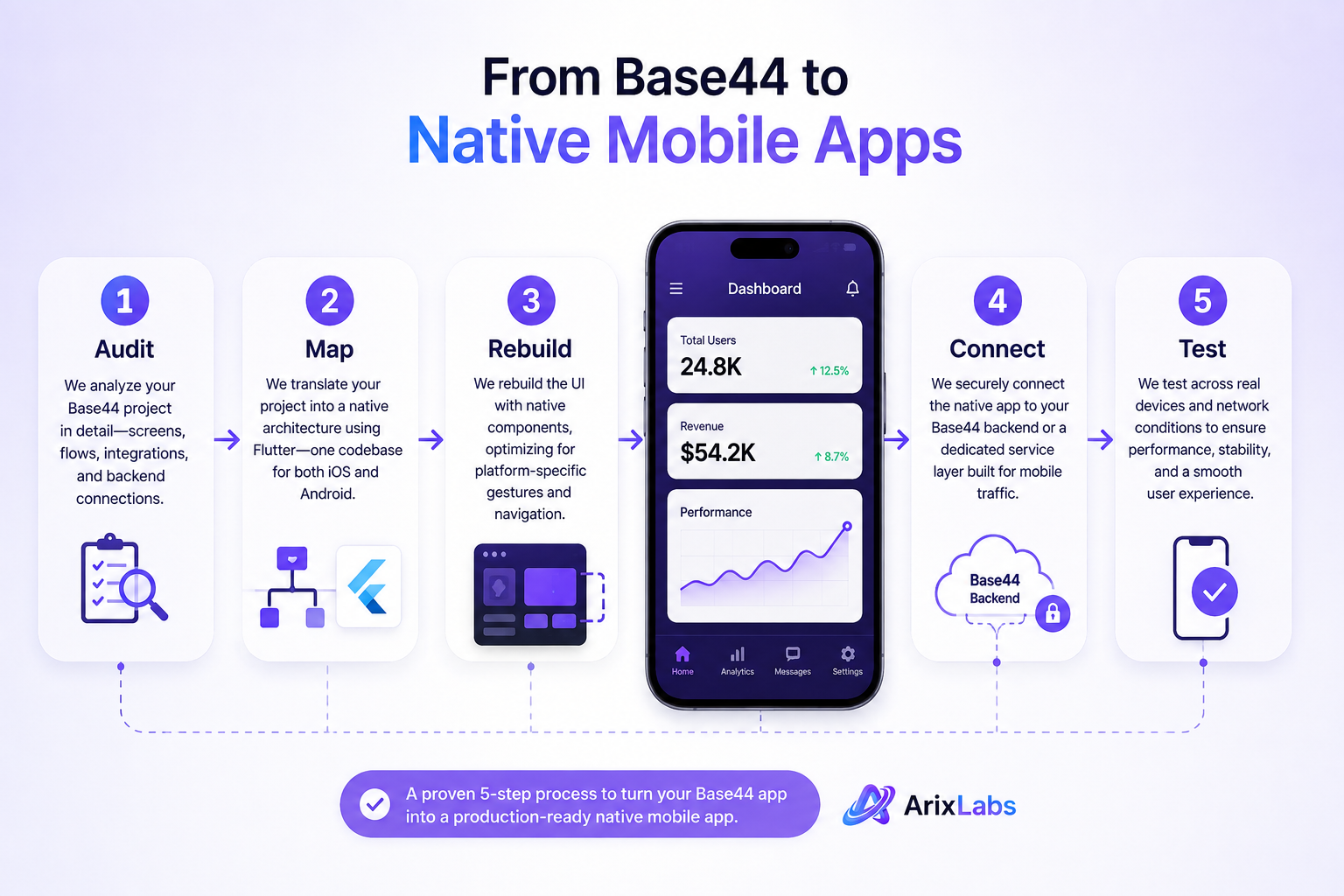
ArixLabs runs the same five-step sequence on every engagement: audit, map, rebuild, connect, test. The audit catalogs every screen, flow, and integration in the existing Base44 project. The map translates that catalog into a native architecture, almost always Flutter, so one codebase ships to both iOS and Android. The rebuild reconstructs the interface using native components instead of web components, respecting platform-specific gestures and navigation patterns instead of forcing a browser layout onto a phone screen. This rebuild stage is where Base44 mobile developers for hire either prove their Base44-specific experience or reveal they are learning it on the job. The connect phase wires the new native frontend back to the Base44 backend or a dedicated service layer built for mobile traffic. This connection work is one of the clearest differentiators of a genuine Base44 mobile app development company, since a poorly wired backend integration causes more production issues than any interface mistake. The test phase puts the app through real devices and real network conditions before anything reaches a store listing. This five-step sequence is the backbone of every Base44 native application services engagement ArixLabs runs, and it is what a founder should expect from any legitimate Base44 mobile app development company, not just ArixLabs specifically. This is what a genuine Base44 mobile app development company actually does differently from a generic mobile shop unfamiliar with how Base44 projects are structured underneath their web interface. The same five-step discipline applies whether the engagement is labeled Base44 native application services, work from a Base44 app development agency, a project run by Base44 mobile developers for hire, or a full Base44 production mobile development rollout.
3. Can a Base44 web app be turned into a native mobile app?
Yes, and ArixLabs has done this often enough to know exactly where the friction usually hides. A Base44 web app can become a real native mobile app, but the transition is a rebuild of the interface layer, not an export or a simple wrapper.
3.1 How to reuse Base44 functionality?
The parts worth carrying over are the data model, the business rules, the user roles, and the workflow logic, since none of that depends on Base44's web-specific rendering technology. What has to be rebuilt is everything visual: buttons, forms, navigation, and layout, because a page designed for a browser does not translate directly onto a five-inch touchscreen. Recognizing this distinction early is exactly what separates a thoughtful Base44 production mobile development plan from a rushed one that tries to reuse interface code that was never built for a native environment. This is exactly the kind of work a serious Base44 native application services provider specializes in, treating the existing build as a detailed specification rather than a codebase to copy wholesale. That specialization is what separates a real Base44 mobile app development company from a Base44 app development agency treating Base44 as just another web platform, and it is why Base44 mobile developers for hire with prior Base44 experience finish this stage faster than generalists. Founders who skip this specialization check often discover the gap only after paying for a rebuild that still is not real Base44 native application services.
4. What are the options for taking a Base44 app to iOS and Android?
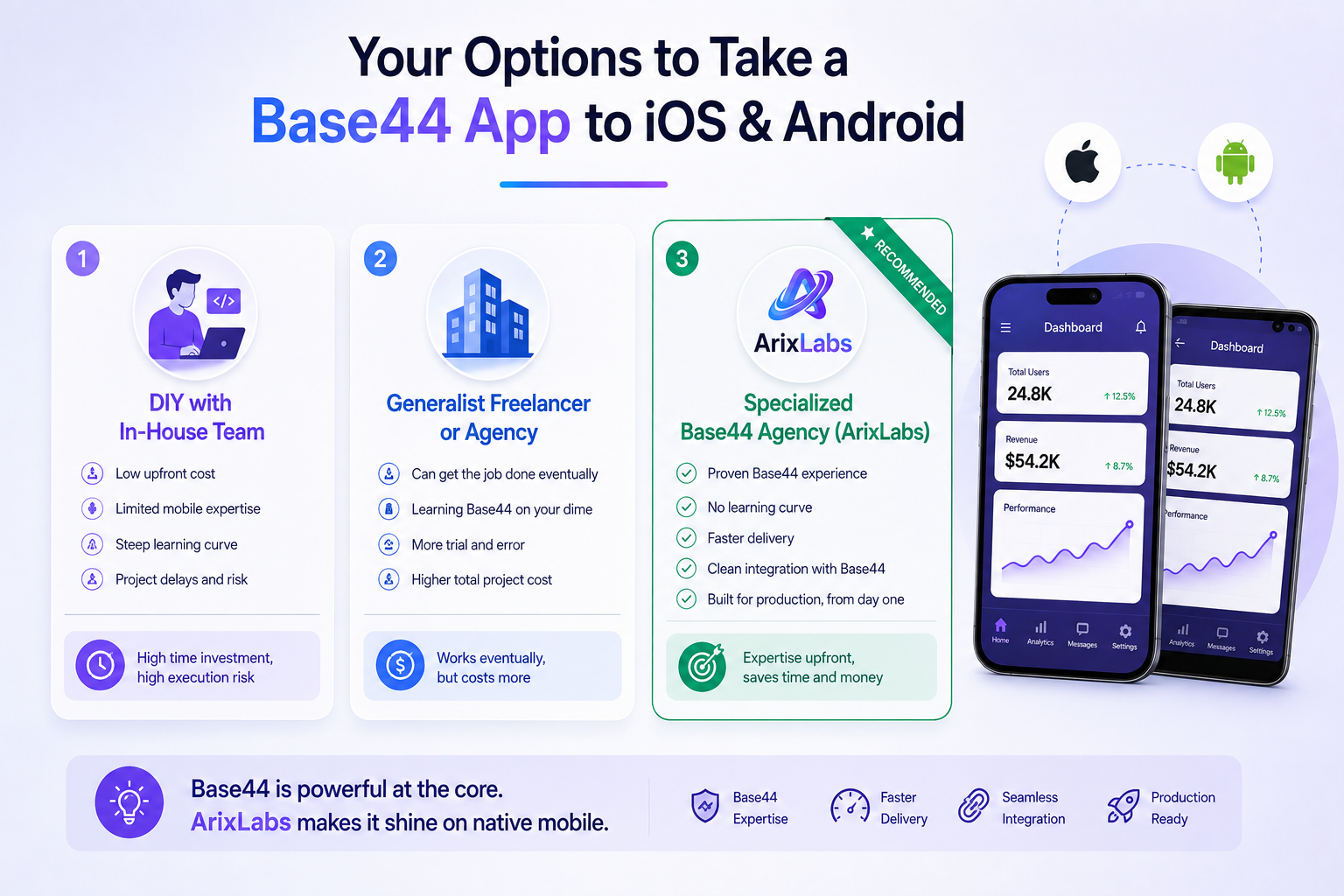
Founders generally weigh three paths: a DIY attempt using in-house resources, a generalist freelancer or agency unfamiliar with Base44 specifically, or a specialized Base44 app development agency that has already solved this exact problem multiple times. This decision is really a question of how much a founder values professional Base44 app development experience versus a lower quote from a team still learning. The DIY path usually stalls once the team realizes native development requires different skills entirely from prompt-based web building. The generalist path often works eventually but costs more in trial and error, since the agency is learning Base44's architecture on the client's clock. This is precisely where a specialized Base44 production mobile development partner earns its fee, closing a learning curve that a generic Base44 mobile app development company would otherwise pass on to the client as wasted budget. Paying for that experience upfront is almost always cheaper than paying for professional Base44 app development lessons learned the hard way, mid-project. How to integrate Base44 data with mobile? This question alone trips up teams unfamiliar with Base44's backend structure, since connecting a native frontend to Base44 data cleanly requires understanding exactly how the platform exposes its APIs. Getting this integration right on the first attempt is a hallmark of professional Base44 app development, not a lucky outcome. Working with Base44 mobile developers for hire who have already mapped this territory removes that entire learning curve from the timeline. This is precisely the value a specialized Base44 app development agency brings compared to a generalist Base44 mobile app development company without Base44-specific experience, and it is one reason professional Base44 app development work increasingly goes to teams with a documented Base44 production mobile development track record instead of the lowest bidder.
5. Can an existing Base44 application support a native mobile experience?
In almost every case, yes, provided the backend is documented well enough for a native client to connect to it reliably.
5.1 What happens to the backend when a Base44 app goes mobile?
The backend typically stays largely intact, since it already handles the data, authentication, and business logic that a native app needs; what changes is how that backend gets consumed, moving from browser-based sessions to token-based authentication suited to mobile devices. This backend continuity is one reason a Base44 app development agency experienced with Base44 specifically can move faster than Base44 mobile developers for hire who are encountering the platform's structure for the first time, and it is a detail that separates real Base44 native application services from a rebuild-everything approach.
5.2 Can the same Base44 backend power both web and mobile apps?
Yes, this is actually the most common outcome: the original Base44 web app keeps running exactly as it did, while a new native app connects to the same backend through the same or lightly extended API layer. Founders often find this reassuring once they understand it, since it means choosing Base44 mobile developers for hire does not mean rebuilding the entire product from the ground up, only the parts that genuinely need to change for a native environment. This dual-support model is core to how ArixLabs structures every Base44 production mobile development engagement, since keeping the web version live during development protects revenue and user trust throughout the build. This same dual-support approach is standard across every Base44 native application services project, whether the client found ArixLabs while searching for a Base44 mobile app development company, a Base44 app development agency, or simply Base44 mobile developers for hire who understood the backend already in place. A poorly scoped Base44 production mobile development project skips this dual-support step and risks breaking the live web app in the process.
6. How does ArixLabs improve Base44 for production?
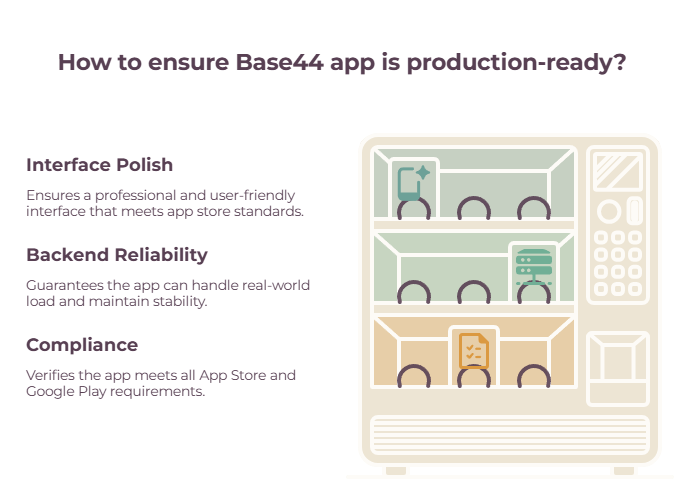
Getting a Base44 app production-ready means closing three gaps that a prototype never had to close: interface polish, backend reliability under real load, and full compliance with App Store and Google Play requirements.
6.1 What testing does ArixLabs perform on Base44 apps?
Every build goes through functional testing across core user flows, device-specific testing across different screen sizes and operating system versions, and performance testing under weak signal and low battery conditions, since these are exactly the scenarios that cause real-world app failures that a browser-based Base44 project never had to handle. Closing all three gaps consistently is what separates genuine Base44 native application services from a surface-level redesign that looks native but has not actually been hardened for production traffic. Skipping any of these three is the fastest way to end up with an app that looks like professional Base44 app development on the surface but fails the moment real users start relying on it. This full testing discipline is a core part of every professional Base44 app development engagement ArixLabs runs, because an app that passes review but breaks in the field is not actually production-ready no matter what the store listing says. This is exactly the standard a genuine Base44 mobile app development company should be held to, and it is what separates real Base44 production mobile development from a rushed Base44 app development agency rebuild that skips real-device testing to hit a deadline.
7. Why choose ArixLabs for a Base44 mobile app?
Founders choose ArixLabs because the team has already solved the specific problems that come up in a Base44 mobile rebuild, rather than treating each project as a fresh technical mystery. As a Base44 mobile app development company with a proven audit-to-launch process, ArixLabs holds the number one global ranking on the FlutterFlow Expert Portal and has shipped more than 100 production apps, a track record that matters directly when the work at hand is Base44 native application services. That track record is the clearest signal of professional Base44 app development a founder can look for, more reliable than any pitch deck from a Base44 app development agency without shipped Base44 apps to point to. Compared to a generalist Base44 app development agency learning Base44's structure for the first time, or Base44 mobile developers for hire without a documented process, ArixLabs brings a repeatable playbook that has already been tested across dozens of real client builds. That playbook is exactly what defines professional Base44 app development work at this level, and it is the reason ArixLabs consistently gets shortlisted alongside every other serious Base44 mobile app development company a founder considers. For founders evaluating Base44 production mobile development partners, that combination of specialization and track record is usually the deciding factor, and it is exactly why professional Base44 app development work keeps landing at ArixLabs rather than a generic development shop. Founders comparing a Base44 mobile app development company against a broader Base44 app development agency almost always find that Base44-specific experience, not general mobile experience, is what actually predicts a smooth Base44 production mobile development timeline.
8. Frequently Asked Questions
1. Why does a Base44 web interface need to be redesigned for mobile?
A layout built for a mouse and a wide browser window does not fit a five-inch touchscreen without real redesign work, covering navigation, touch targets, and form design suited to a phone rather than a desktop browser. This redesign work is standard across any serious Base44 native application services engagement, regardless of which agency performs it.
2. Can my Base44 web app stay live during development?
Yes. The Base44 web app keeps running for existing users while ArixLabs builds the native app separately, so there is no downtime or lost revenue during the Base44 production mobile development process. This is one advantage of working with Base44 mobile developers for hire who understand how to keep both versions running in parallel.
3. Can ArixLabs build custom iOS and Android apps?
Yes. ArixLabs builds custom native iOS and Android apps from Flutter, connecting them to a Base44 backend or a dedicated service layer as part of a full Base44 native application services engagement, the same scope covered by any credible Base44 app development agency.
4. Does ArixLabs support Base44 apps after launch?
Yes. Post-launch support covers bug fixes, feature updates, and store compliance as Apple and Google update their requirements, which is standard for any Base44 mobile app development company running a long-term client relationship rather than a one-time handoff, and it is part of what defines genuinely professional Base44 app development work.
%20(1).jpg)

View more blogs
.png)
%20(1).jpg)
.png)
.png)


.png)
.png)
Ready to develop your own product? Get in touch today!
Get in Touch