





Introduction
Most businesses don't fail because of a bad idea. They fail because the software behind that idea can't keep up once real users show up. That's the gap React JS web app development was built to close. Founders come to us with a feature list and a launch date, and the question underneath it is always the same: will this hold up in six months, or need a rebuild? At Arixlabs (previously FlutterFlowDevs), that question comes up on almost every first call, which is why this breakdown covers how a React JS build actually works, start to finish. If you're trying to build web application using React JS as your foundation, that question has a straightforward answer, and it starts with understanding why the framework behaves so differently from what came before it. React JS frontend development services exist precisely because this gap between "it works in a demo" and "it works under real load" keeps showing up, project after project, industry after industry. And for teams racing against a deadline, fast web app development React offers a rare combination: speed now without paying for it later in bugs, rewrites, or a codebase nobody wants to touch.
1. What makes React JS ideal for building web applications?
React JS is built around reusable components, and that single design choice changes almost everything about how a scalable React JS application gets built. Instead of one giant page of code, developers build small pieces, a button here, a form there, a nav bar elsewhere, and snap them together, forming a scalable React JS application from the ground up. This isn't just tidier code, it's the backbone of build web application using React JS projects where five developers work on five parts of one app without collision. For React JS for business websites, that translates into faster iteration and fewer bugs slipping through during updates. A virtual DOM sits underneath all of it, updating only the parts of a page that actually changed instead of redrawing the whole screen every time. The result is snappier interfaces on modest hardware, a hallmark of solid React JS frontend development services. React JS web app development also benefits from one of the largest developer communities in the industry, which means most problems you'll hit have already been solved by someone else. That matters when a deadline is two weeks away and something breaks at 11 p.m., which is when fast web app development React support pays for itself. Teams that want to build web application using React JS the right way from day one usually spend the first week just mapping out the component structure, because a messy component tree early on is the single most common reason projects slow down later. Get that map right and everything downstream gets easier, the real payoff of disciplined build web application using React JS planning. This is also why React JS frontend development services built around a disciplined component library tend to outlast quick, unstructured builds by years, not months.
1.1 How does component-based architecture improve development speed?
Reusable components mean a login form built once gets used on ten different pages instead of rebuilt each time. Developers spend less time recreating logic and more time building new functionality, which shortens delivery timelines across the entire project. This is one of the quieter reasons React JS web app development outpaces frameworks built around monolithic templates, where changing one shared element means touching a dozen files instead of one, a direct win for anyone trying to build web application using React JS at speed.
2. How does React JS help a web app scale as users grow?
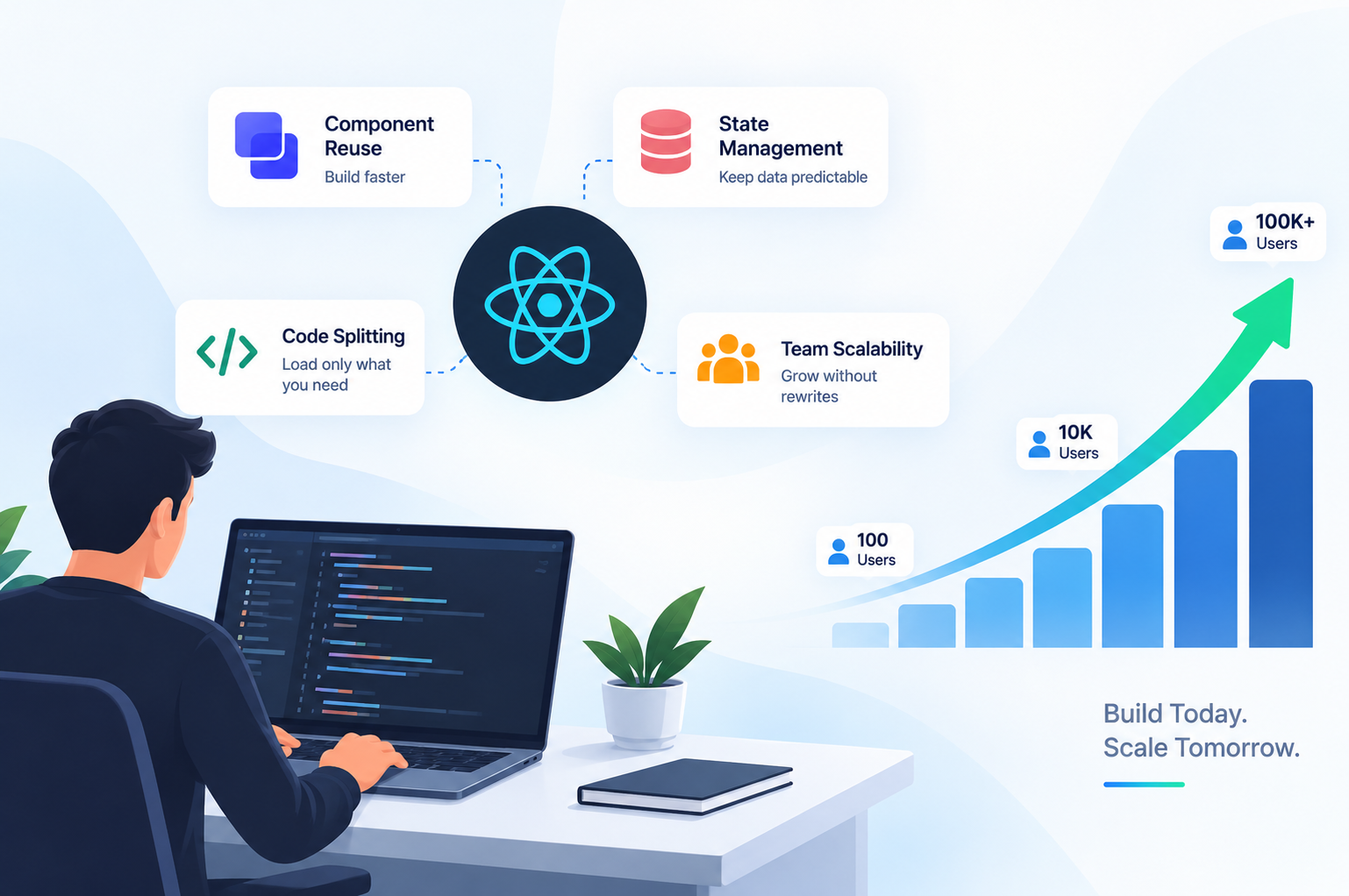
Scaling isn't just "will the server handle more traffic." A scalable React JS application scales in three directions at once: user load, feature count, and team size. Component reuse means new features don't require rewriting old ones, a habit central to any scalable React JS application. State management libraries like Redux keep data predictable as a build web application using React JS project balloons from ten screens to a hundred. Code splitting lets React JS load only what a user needs on a given page, so an app with two hundred features doesn't feel bloated on page one, which matters enormously for React JS web app development aimed at mobile users on slower connections. This is where React JS web app development earns its reputation. We've watched apps go from a few hundred users to tens of thousands without a rebuild, because a scalable React JS application is designed for growth from day one, not patched together under pressure. Businesses that treat React JS for business websites scalability as a launch-day decision, not a later fix, save themselves brutal rewrites down the line. Fast web app development React teams practice looks boring from the outside because nothing breaks. That's the point. A scalable React JS application doesn't announce itself with fireworks, it just keeps working when the traffic graph spikes on launch day, or when a marketing campaign sends ten times the usual visitor count to a page that was never stress-tested. React JS for business websites that anticipate this kind of growth early tend to sail through moments that would knock a poorly structured competitor offline entirely.
2.1 How is state management handled in large React JS applications?
Smaller apps often get by with React's built-in Context API, but larger ones typically move to Redux or Zustand once the data flowing between components gets complex enough to cause bugs. The switch usually happens naturally as the app grows, not as a decision made upfront, which is exactly how React JS web app development should evolve, driven by real need rather than guesswork. Getting this right early separates a genuinely scalable React JS application from one that breaks with every new feature, a common failure point in React JS frontend development services that skip planning.
2.2 What role does React play in improving page load performance?
The virtual DOM updates only the parts of a page that changed, avoiding full page reloads. Combined with code splitting and lazy loading, this keeps initial load times low even as an app's total feature set expands, a detail that separates rushed builds from genuine fast web app development React work. For React JS for business websites competing on speed, particularly e-commerce and lead-generation pages, this difference shows up directly in conversion rates, which is exactly what fast web app development React is meant to protect.
3. What is the typical process for building a web app in React JS?
The process usually runs through five stages:
- Discovery, where requirements and goals get pinned down
- Design, translating requirements into wireframes and a component map
- Development, building core flows before polish
- Testing, run in parallel rather than saved for the end
- Deployment, shipping through a continuous integration pipeline
Vague requirements are the biggest cause of scope creep later, so discovery gets treated as its own stage. Design work, the groundwork every solid React JS frontend development services team insists on, happens before a single line of code gets written. Development is where teams build web application using React JS logic piece by piece, starting with authentication and data fetching before the polish. Catching a bug on day three is cheap and catching it on launch day is expensive, especially for a scalable React JS application meant to run for years, which is why testing runs alongside development instead of after it. Deployment for React JS for business websites typically uses continuous integration, so updates ship in minutes, another reason fast web app development React delivery beats older release cycles. Arixlabs (previously FlutterFlowDevs) follows this sequence on every build, adjusting the weighting for a fast MVP or a hardened product. Neither approach is wrong, they answer different questions. Our own React JS frontend development services lean heavily on this staged approach because skipping discovery to save a week upfront almost always costs three weeks later, once assumptions turn out to be wrong. If the goal is fast web app development React without sacrificing quality, this is the sequence that actually delivers it, not shortcuts that skip testing to hit an arbitrary date. Clients who ask us to build web application using React JS on a tight runway usually get the best results when they trust this sequence rather than pushing to skip straight to development, since the stages that feel slow upfront are exactly what prevents rework later. A genuinely scalable React JS application is rarely the product of rushed planning, even when the build itself moves fast.
3.1 Which backend technologies pair well with a React JS frontend?
Node.js is the most common pairing since both run on JavaScript, keeping the tech stack simpler for any team trying to build web application using React JS without juggling two different languages. Firebase, Django, and Laravel integrate cleanly too, and the choice comes down to existing infrastructure, a call any React JS frontend development services partner should help make. Whichever backend gets chosen, the goal for any team trying to build web application using React JS well is a clean API contract, so frontend and backend developers work independently without blocking each other.

4. How much does it cost to build a web application in React JS?
Cost typically starts around a few thousand dollars for a lean MVP and climbs with integrations and backend complexity, standard for any React JS web app development quote. A React JS web app development project with a handful of screens and a simple database costs far less than one syncing with five external APIs and handling real-time data. React JS frontend development services generally price lower than comparable native development because a single React codebase can share more logic across platforms than fully separate native builds require. Anyone who quotes an exact number before understanding requirements is guessing. What we can say is that fast web app development React projects with a tight, well-scoped list almost always land cheaper than open-ended builds where the spec keeps shifting. A scalable React JS application built with future features in mind often costs a bit more upfront than a quick throwaway prototype, but it avoids the far larger bill that comes with rebuilding a React JS for business websites platform from scratch two years in, once the original shortcuts start failing under real usage.
5. How long does it take to develop a React JS web app?
Timelines vary, but a straightforward fast web app development React MVP usually takes six to ten weeks from kickoff to launch. More complex projects, involving multiple user roles or payment processing, typically run three to six months. React JS for business websites with simpler needs, a marketing site with a contact form and a blog, for instance, can be done in a fraction of that time. What stretches timelines isn't the coding, it's unclear requirements and slow feedback loops, the two things that sabotage most fast web app development React promises. Teams that commit to fast turnaround on approvals see their React JS web app development timeline shrink dramatically, sometimes by a third. If speed matters most, tell your React JS frontend development services team upfront so sprints get structured around it, not discovered halfway through. This is really what fast web app development React comes down to in practice, not magic tooling, but tight feedback loops and a client who reviews builds the same day instead of the same month. React JS frontend development services priced around fixed sprints tend to produce the most predictable timelines, since scope is locked before development starts rather than negotiated mid-sprint. Businesses chasing fast web app development React timelines without a fixed-sprint structure often get the opposite, a build that never finishes as scope keeps expanding.
6. What industries benefit most from React JS web applications?
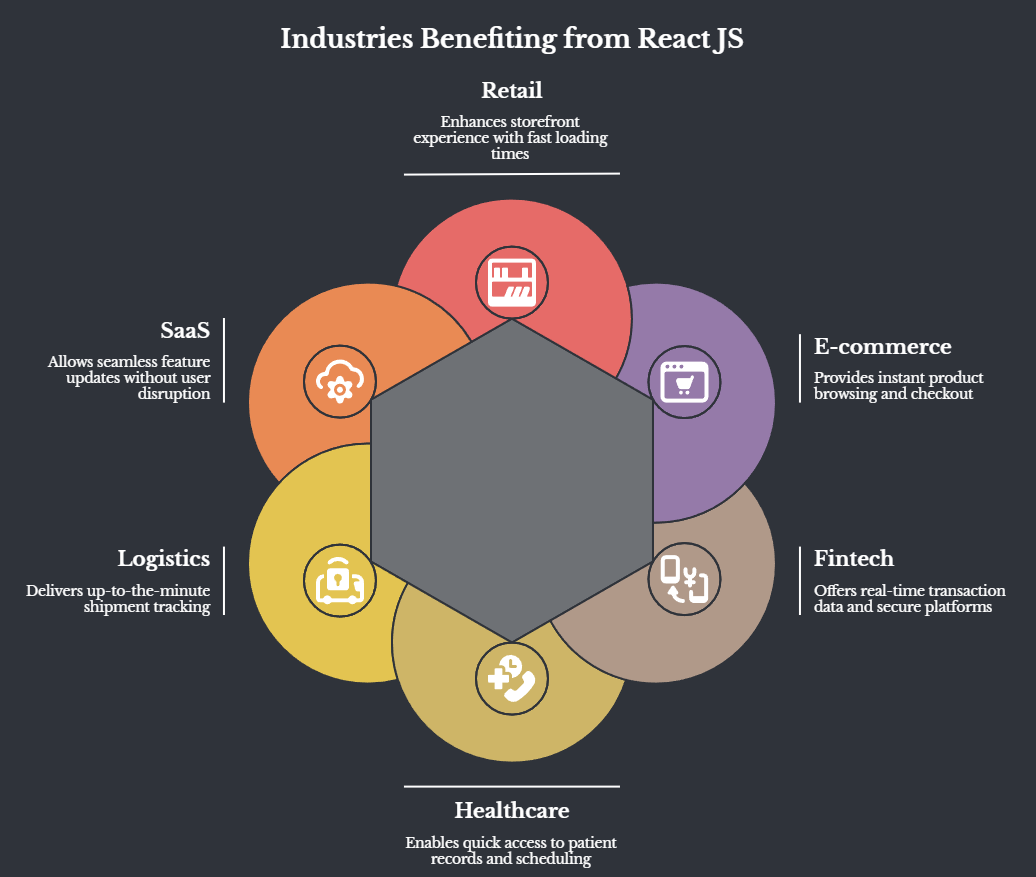
E-commerce, fintech, healthcare, logistics, and SaaS platforms lean on React JS for business websites more than most, largely because these industries need interfaces that update constantly without reloading the page:
- Fintech: live transaction data on a scalable React JS application
- Logistics: shipment dashboards refreshing every few seconds
- Healthcare: React JS for business websites and patient portals with instant record access
- SaaS: React JS frontend development services that ship new features without disrupting existing users
- Retail: storefronts that feel instant, since a slow product page directly costs sales
That last point is another reason React JS for business websites in retail keep outperforming older stacks. Almost any business with a dashboard or customer-facing tool built on frequent data updates ends up looking at build web application using React JS sooner or later. Even industries that don't seem software-heavy, clinic scheduling systems, local service marketplaces, quietly run on the same build web application using React JS pattern, because live data without a page reload is a universal problem across React JS for business websites.
6.1 How is SEO handled for React JS web applications?
Server-side rendering frameworks like Next.js solve the SEO weakness of client-rendered React JS web app development by delivering fully rendered HTML to search engines. For a marketing-facing site, this is close to mandatory rather than optional. Any React JS frontend development services provider worth hiring raises this before development starts, not after the site is live and rankings are already suffering.
Frequently Asked Questions
1. Is React JS good for small business websites?
Yes. Its component structure keeps a small site's codebase organized, and it scales easily if the business grows, which is why so many React JS for business websites start small and expand without a rebuild.
2. Can React JS handle high-traffic applications?
Absolutely. Companies like Facebook and Instagram run on React at massive scale, and with proper caching and backend architecture, high traffic is rarely the bottleneck for a well-built scalable React JS application.
3. Do I need a separate mobile app if I build in React JS?
Not necessarily. A responsive React JS web app development approach works well on mobile browsers, though a dedicated app makes sense if you need push notifications or offline access.
4. Is React JS more expensive than other frontend frameworks?
No, development costs are generally comparable to or lower than alternatives, partly because of the large talent pool and reusable component libraries available. For most businesses evaluating React JS web app development against other options, the deciding factor ends up being long-term maintenance cost rather than the initial build, and that's usually where React JS pulls ahead.
%20(1).jpg)

View more blogs


.png)
.png)
.png)

_a_change__2025__to__20.png)
.png)
.png)
Ready to develop your own product? Get in touch today!
Get in Touch