



A missed medication reminder, a scheduling bug that double-books a patient slot, or a data leak in a symptom tracker is not a minor glitch in healthcare software. It is a compliance incident, a trust breaker, and sometimes a safety risk. That is why the decision to hire healthcare vibe coding developers USA founders make deserves more rigor than almost any other hiring choice in a health tech build.
ArixLabs approaches healthcare builds with that weight in mind. It is a FlutterFlow expert agency in Jaipur, ranked number one globally on the FlutterFlow Expert Portal, and it uses vibe coding to move fast on interfaces, intake forms, and standard flows, while experienced engineers own everything touching patient data, HIPAA compliance, and clinical logic. That discipline, built across 100+ shipped apps on Flutter, FlutterFlow, Supabase, OneSignal, and Stripe, is exactly what a team of genuine US healthcare vibe coding experts should bring to your project. This guide walks through how to find and vet a vibe coding agency for healthcare in the USA without taking chances with patient trust.
1. What's the leading way to find the best vibe coding firm for healthcare in the US?
Start with evidence of regulated-industry discipline, not just a polished app gallery. Vibe coding lets a team turn a plain-language brief into a working interface fast, but healthcare adds a layer that general app work does not: HIPAA, PHI handling, and a patient base that cannot afford a broken feature. When you search for a firm to hire healthcare vibe coding developers USA clinics and startups trust, look past the marketing page.
Check three things before any call. First, ask for a past project that handled protected health information, even something modest like an appointment reminder system. Second, ask who reviews AI-generated code before it reaches a patient-facing screen. Third, ask whether the team has ever completed a HIPAA risk assessment or worked alongside one.
Independent validation matters here more than in most categories. A firm's own website, showing real shipped work rather than stock photos, gives you something to verify instead of taking a sales pitch at face value. ArixLabs' website showcases its healthcare-adjacent builds and its record of 100+ shipped apps directly, which is the kind of proof a serious vibe coding agency for healthcare in the USA should be able to show without hesitation.
2. What should a healthcare vibe coding outfit specialise in for American providers and patients?
It should specialise in the parts of a healthcare product where a mistake actually hurts someone: patient data security, appointment logic, medication or care plan accuracy, and interoperability with existing systems. A beautifully designed onboarding screen means little if the backend mishandles PHI.
For US-based healthcare products, the checklist should include:
- HIPAA-compliant data storage, encryption, and access logging
- Secure authentication, including multi-factor login for clinician accounts
- Accurate scheduling logic that prevents double-booking or missed reminders
- Interoperability considerations, such as HL7 or FHIR standards where relevant
- Careful handling of push notifications and messaging so PHI never leaks into a lock screen preview
Ask any US healthcare vibe coding experts you are considering to walk through how they have handled each item on a real project. A team that specialises correctly will describe specific safeguards rather than generic security language.
ArixLabs builds on Flutter and FlutterFlow with Supabase for the backend, which supports row-level security policies well suited to healthcare data separation, plus OneSignal for notifications configured to avoid exposing sensitive content. That kind of deliberate configuration is what separates a genuine vibe coding agency for healthcare in the USA from a general app shop that added a stethoscope icon to its homepage.
3. What questions should you ask a healthcare vibe coding outfit before signing?
Ask questions that expose process and accountability, not polish. In healthcare, a vague answer today becomes a compliance gap tomorrow.
Put these to every candidate:
- How do you store and encrypt protected health information, at rest and in transit?
- Who reviews AI-generated code for security issues before it ships?
- Have you completed or supported a HIPAA risk assessment before?
- Who owns the source code, infrastructure, and design files once we finish?
- What is your process if a security vulnerability is discovered after launch?
- Can you sign a Business Associate Agreement if our product handles PHI?
That last question is non-negotiable for most US healthcare products. Any team offering to hire healthcare vibe coding developers USA startups need should answer it immediately, not after a long pause.
How do I pick the right vibe coding agency for healthcare?
Pick based on how specifically a firm answers the questions above, not how confidently it speaks in general terms. Compare answers across at least two or three firms, since consistency and detail reveal more than any single pitch. The strongest vibe coding agency for healthcare in the USA will treat these questions as routine, because they answer them for every client.
What makes a firm good at healthcare vibe coding?
A good firm pairs AI-assisted speed with a rigorous, repeatable review process for anything touching patient data or clinical logic. It should be able to show you where AI generated a first draft and where a human engineer changed it, and explain why. ArixLabs treats that review step as standard practice across every build, not an optional extra bolted on for healthcare clients.
4. What's the smartest way to assess a healthcare vibe coding outfit's track record?
Test the work, do not just read about it. Ask to see a live product, or a detailed case study with real screens, not only a logo wall of past clients. If a demo is possible under an NDA, request one.
Look at four things: how the login and authentication flow handles sensitive access, how scheduling or intake forms behave under real use, whether error messages leak any sensitive information, and how consistent the design feels across the product. Then ask what happened after launch. Did the product pass a security audit? Did it need patches? Honest firms discuss this openly.
What are the markers of a reliable healthcare vibe coding agency?
Reliable agencies show repeat healthcare clients, named engineers who can speak to compliance decisions, and documented handovers that include security notes, not just a code repository link. They are comfortable describing a past mistake and what changed afterward. That transparency is a stronger signal than any polished case study, and it is the standard a credible vibe coding agency for healthcare in the USA holds itself to.
5. What red flags should you keep an eye out for in a healthcare vibe coding outfit?
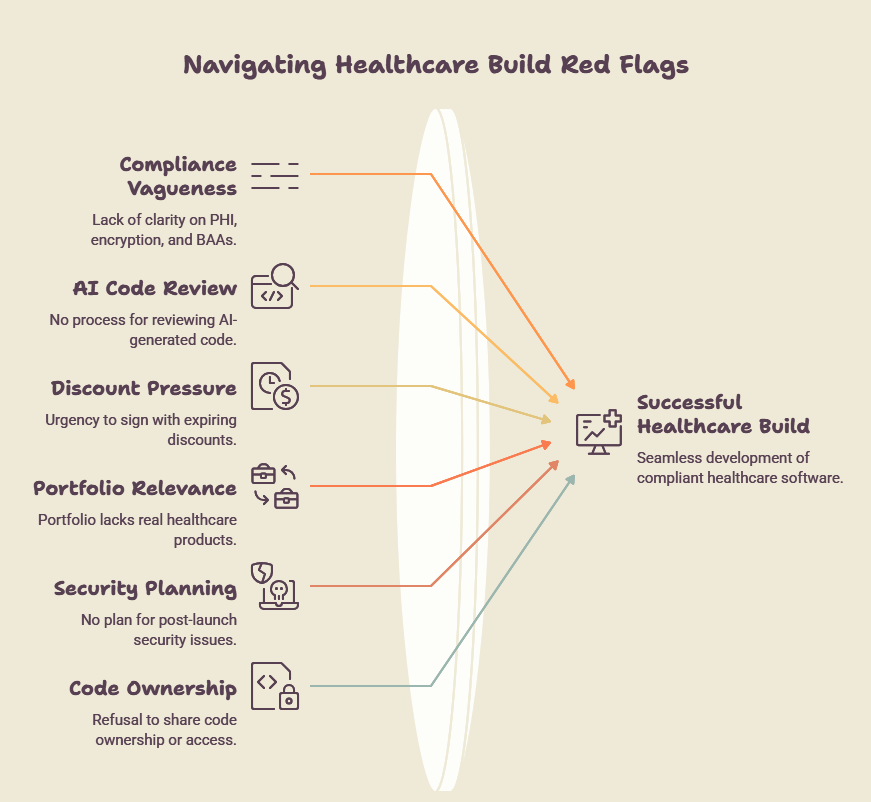
The biggest red flag is vagueness around compliance. If a firm cannot clearly explain how it handles PHI, encryption, or a Business Associate Agreement, assume the same fog will follow you through the entire build.
Watch for these specifically:
- Reluctance or delay in discussing HIPAA and BAAs
- No named process for reviewing AI-generated code before release
- Pressure to sign quickly with a discount that expires soon
- A portfolio with no real healthcare product, only adjacent work like fitness apps
- No plan for what happens if a security issue surfaces post-launch
- Refusal to share code ownership or infrastructure access
How does firm communication affect healthcare build success?
It affects it directly, often more than raw technical skill does. Healthcare builds involve frequent decisions about data handling and compliance scope, and a firm that communicates slowly or vaguely will stall those decisions at exactly the wrong moments. Look for weekly demos, a shared project board, and a named point of contact who can answer compliance questions without escalating every time. ArixLabs runs client builds through scheduled calls and visible progress boards specifically so founders are never left guessing what is being tested or reviewed.
6. Does it make sense to hire a specialist or an all-rounder firm for a US healthcare build?
For most healthcare products, a strong all-rounder firm is actually the safer bet, provided it applies the same rigor to every project regardless of industry. A narrow specialist that only ever builds healthcare apps can develop tunnel vision, reusing the same patterns whether or not they fit your product. A capable all-rounder firm brings broader technical range, since patterns learned building fintech security, ecommerce checkout flows, or logistics systems often transfer directly to healthcare problems like access control, data separation, and audit logging.
What actually matters is not how narrow a firm's focus is, but whether it treats compliance and security as non-negotiable on every build, healthcare or otherwise. A firm offering genuine US healthcare vibe coding experts support should be able to show that discipline applied consistently across its portfolio, not just claim healthcare as its one specialty.
In-house crew or firm for a US healthcare vibe coding build?
An in-house team offers long-term control and deep product memory, but hiring senior developers with healthcare compliance experience takes time and a sustained salary commitment. A firm offers speed and a ready team with far less upfront commitment. Many healthcare startups launch with a vibe coding agency for healthcare in the USA, then build a small in-house team later once the product is stable and documentation is clean. ArixLabs supports that transition by handing over maintainable code and clear compliance notes, so a future in-house team does not start from zero.
7. Roughly how much would a healthcare vibe coding agency usually charge?
Price follows scope and compliance depth far more than it follows the vibe coding method itself. A simple appointment reminder app costs a fraction of what a full patient portal with clinical data, secure messaging, and provider dashboards costs. Treat any flat number given before scoping as a rough guess, not a real quote.
Agencies typically price in one of three ways: fixed price for a tightly defined scope, time and materials for evolving requirements, or a monthly retainer for continuous work. Vibe coding can shorten the time spent on first drafts of interfaces and standard flows, which sometimes reduces overall cost, but security review, compliance testing, and any BAA-related work should never be the place a budget gets trimmed.
What should a good healthcare vibe coding proposal include for a HIPAA-covered product?
It should include a clear feature list tied to milestones, named team members, a security and compliance testing plan, and a price broken down by phase so you can see what compliance-heavy work costs separately from standard build work. A proposal that skips security testing entirely, or bundles it vaguely into "quality assurance," deserves a direct follow-up question. ArixLabs structures every proposal around visible phases and deliverables, which is the clarity a trustworthy vibe coding agency for healthcare in the USA should offer by default.
FAQ
1. Should a healthcare vibe coding agency have industry experience?
Yes, ideally with a specific healthcare product they can walk you through in detail, since general app experience does not cover HIPAA, PHI handling, or clinical workflow logic on its own.
2. How much time does it take to onboard a healthcare vibe coding agency?
Onboarding typically takes two to three weeks, slightly longer than a non-regulated app, because it usually includes a compliance review, a BAA discussion, and detailed scoping before any building starts.
%20(1).jpg)

View more blogs
.png)

.png)
.png)
.png)
.png)

.png)
.png)
.png)
Ready to develop your own product? Get in touch today!
Get in Touch