


.png)


- If clients are already asking whether you can "just build it with AI," you are sitting on a resale opportunity you haven't monetized yet.
- Vibe coding for agencies who resell to clients in the USA is becoming one of the fastest ways for small dev shops and marketing agencies to add a build arm without hiring engineers.
- ArixLabs (previously FlutterFlowDevs) builds production apps across both no-code platforms and modern AI-assisted, vibe-coded workflows. That dual capability is exactly what makes a reseller partnership viable, since it means the partner isn't locked into a single tool ecosystem.
- Track record: 80+ apps shipped into production, an Agency of the Year 2026 recognition for execution speed, and a #1 global ranking on one of the platforms it builds on.
- These credentials matter specifically once you start putting your own name on delivered work — you're not just vetting a vendor, you're vetting who stands behind your brand's reputation.
- This piece covers: how white label vibe coding in the USA actually works, what it costs, what to check before signing a vibe coding partnership program in the USA, and where the real risk sits.
1. Can Agencies Resell Vibe Coding Services Under Their Own Brand?
- yes. Agencies across the US are already doing this successfully.
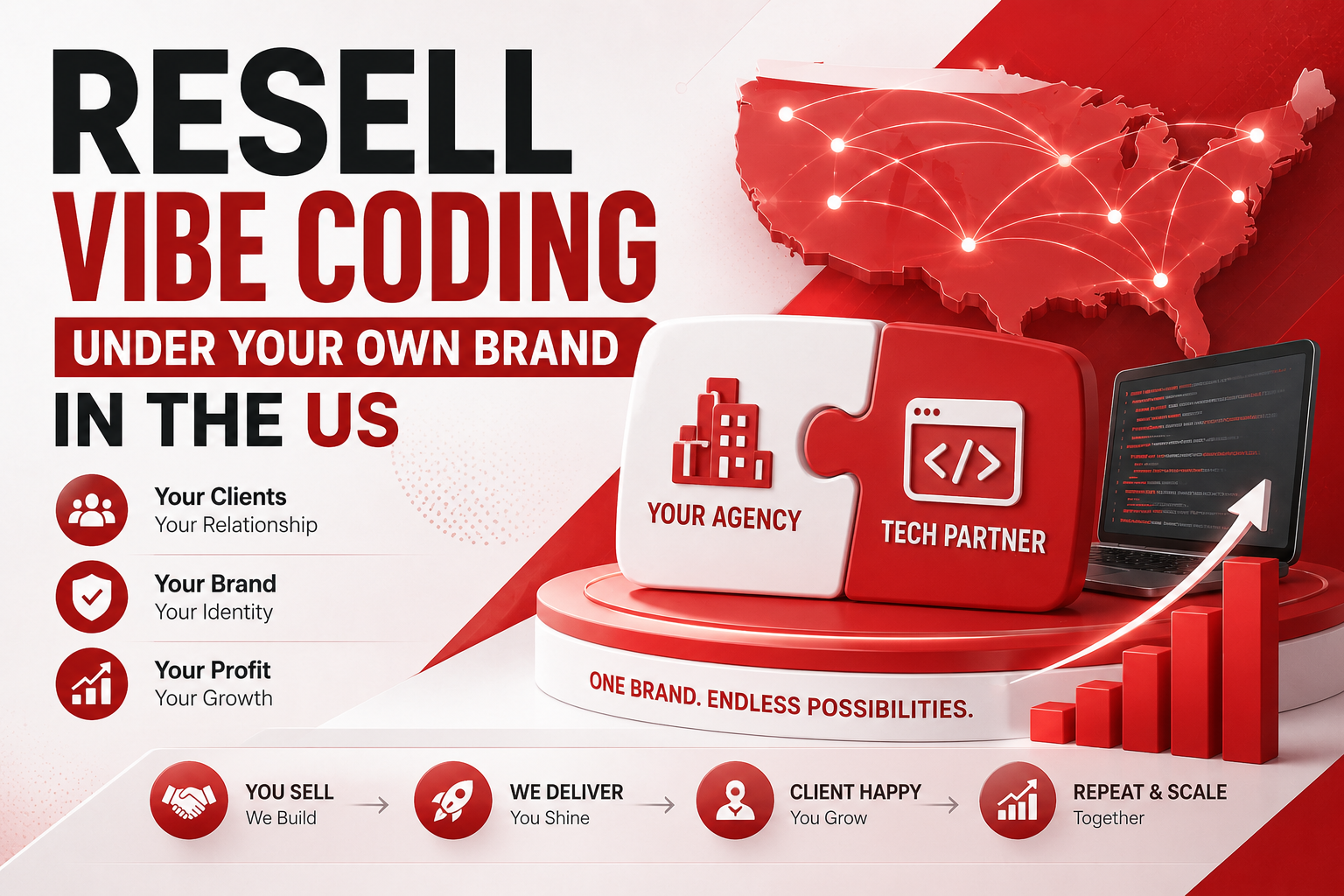
- The model works because the client experiences a single point of contact, while a specialist partner handles the actual technical build behind the scenes.
- Structure: vibe coding for agencies who resell to clients in the USA typically runs through either a white label or a co-branded agreement.
- The reselling agency owns the client relationship, invoicing, and ongoing support.
- The technical partner ships the actual product, handling the engineering side entirely out of view.
- What this unlocks: a marketing or strategy agency can add a new development revenue line without ever hiring an in-house engineer.
- Division of labor:
- Partner responsibilities: architecture, prompting, QA, deployment.
- Agency responsibilities: sales, scoping, account management, client-facing communication.
- The single biggest factor in making this work: both sides need to agree upfront on who owns client communication during build sprints. Ambiguity here is the fastest way to erode trust with the client.
- Agencies that treat the partner as an extension of their own delivery team — rather than something to conceal or manage at arm's length — tend to retain clients longer and expand contract scope faster over time.
- Common rollout pattern: most agencies that succeed at this start with a single test project rather than committing to a full program immediately.
- Once that first pilot ships cleanly, scaling the offering across additional client verticals typically becomes a repeatable playbook instead of a one-off experiment each time.
2. How Does White Label Vibe Coding Actually Work?
- The mechanics are a straightforward handoff:
- The reselling agency sells and manages the client relationship.
- The build partner delivers the actual work under the agency's brand.
- The client typically never sees the partner's name anywhere — not on invoices, not in code repositories, not in any communication.
- Getting this right is mostly a one-time setup cost: build the right systems once, then reuse them across every client that comes through the pipeline afterward.
2.1 White Label vs. Co-Branded — the key distinction
- White label: the client sees only your agency's name at every touchpoint. Full brand control, full brand responsibility.
- Co-branded: the build partner is credited openly alongside your agency — usually in exchange for a lower rate or a faster turnaround.
- Common trajectory: most US agencies start co-branded to build trust with a new partner, then shift to full white label once delivery quality has been proven over a few projects.
2.2 What gets set up once and reused
- Contracts, communication protocols, and staging environments are typically built once per partner relationship and reused across every subsequent client project.
- This reuse is what keeps margins healthy as volume scales — you're not rebuilding infrastructure with every new client.
- ArixLabs structures these handoffs so the reselling agency retains control of every client-facing asset, while the underlying build work stays entirely behind the scenes — a setup that has held up across dozens of resold projects.
- Practical upside: agencies new to this model typically find that their second and third client rollouts take a fraction of the setup time the first one required.
3. What Margins Can Agencies Expect?
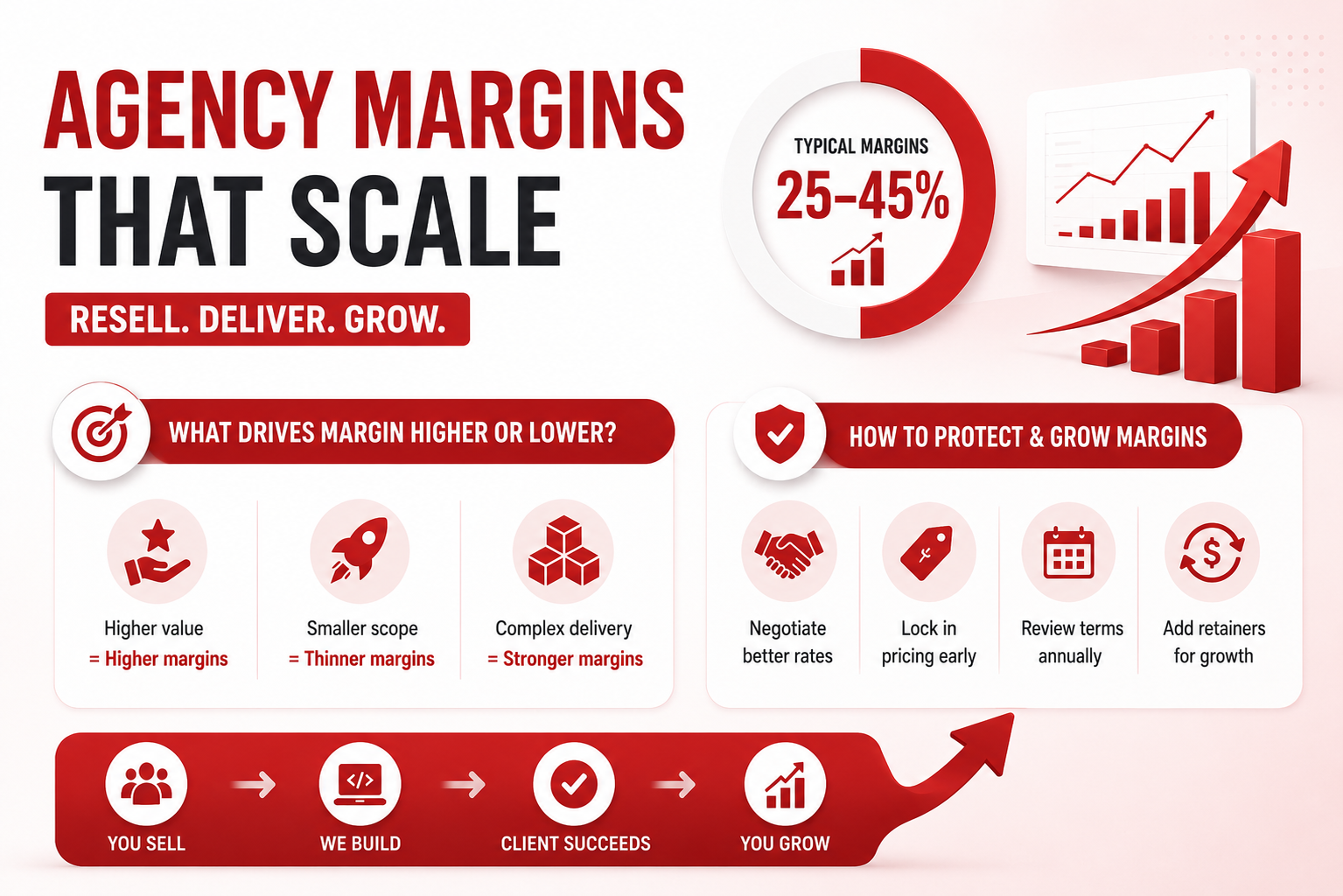
- Typical range: 25–45%, depending on project complexity and how much the reselling agency handles directly versus passing through.
- Pricing structure: the build partner's rate is generally treated as a wholesale cost, and the agency marks up based on scope, urgency, and the overall value of the client relationship.
3.1 What drives margin higher or lower
- Agencies that bundle strategy, design direction, or ongoing support into the resold service tend to command higher margins than those reselling raw build work alone — clients are paying for a full outcome, not just code.
- Smaller MVP builds: thinner margins, because pricing is competitive and clients can easily compare quotes across providers.
- Ongoing retainers and complex multi-feature apps: stronger markup potential, since fewer providers can execute reliably at that level of complexity.
3.2 How to protect and grow margins over time
- Negotiate volume-based wholesale rates rather than paying per-project rates every time — this tends to produce the biggest margin improvement over a year of consistent reselling.
- Lock in tiered pricing early to protect margins as client volume scales.
- Revisit wholesale terms annually — agencies that do this consistently hold onto healthier margins than those that never renegotiate.
- Layer in maintenance retainers after launch. This adds a second, more predictable margin stream on top of the initial build fee, and mature reseller programs tend to lean on this heavily.
4. What Should Agencies Check Before Partnering?
- Three things to check before signing anything: delivery history, code ownership terms, and communication reliability.
- The clearest signal of whether a partner can support resale volume without missing deadlines is their actual shipped output — not their promised capability or pitch deck.
4.1 Contract essentials
- Code ownership must transfer fully to the client or agency — get this in writing, not as a verbal assumption.
- Response time guarantees during active build periods.
- Clear terms for revisions after launch.
- Red flag: avoid any partner unwilling to put ownership and IP terms in writing before the first project even starts.
4.2 Due diligence tactics that actually work
- ArixLabs' credentials (80+ apps shipped, Agency of the Year 2026) hold up under this kind of scrutiny — which is the level of due diligence a serious agency should apply before committing client work to any new partner.
- Check references from other agencies who've resold the partner's work — not just individual end clients. This surfaces reliability issues faster than a single case study ever will.
- Run a short pilot project before committing to a full contract. It's the cheapest way to confirm fit, and it gives both sides a low-stakes opportunity to test communication speed before real client deadlines are on the line.
5. How Should Agencies Present Vibe-Coded Work as Their Own?
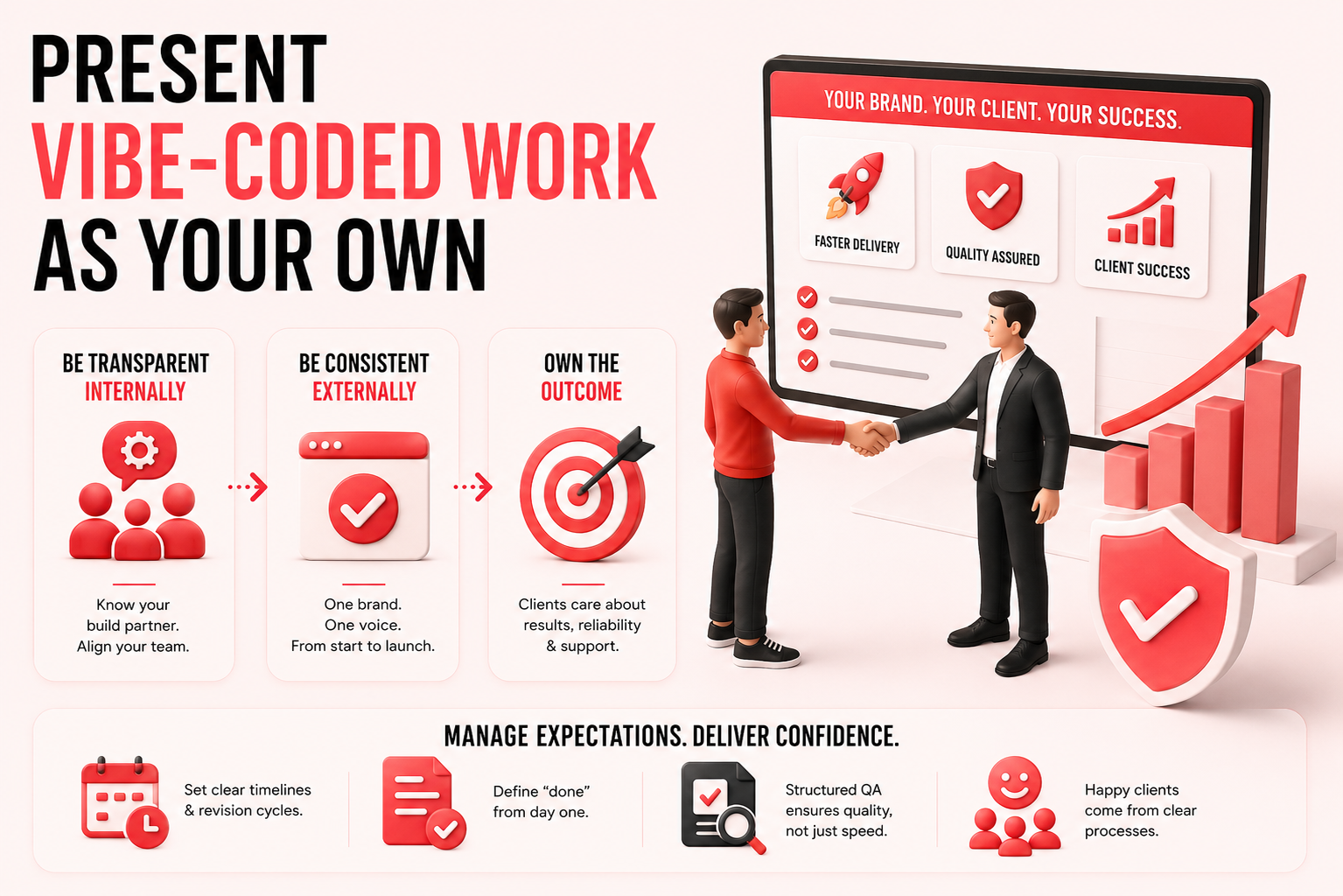
- The top-rated approach: transparency internally, consistency externally.
- Your own team should know exactly how the build partner fits into delivery.
- The client should experience a single, seamless brand from kickoff through launch.
- Pitfall to avoid: agencies that try to fully obscure the partnership from their own account managers usually create internal confusion that eventually leaks through to the client anyway.
5.1 Managing client expectations
- Set expectations early: build timelines, revision cycles, and what "done" actually looks like for an AI-assisted build.
- Important nuance: vibe-coded projects move faster than traditional development, but they still need structured QA before launch — don't let speed create shortcuts in quality assurance.
- Clients who understand the process upfront rarely push back later. Document this process once and reuse it for every future white label engagement.
5.2 The bigger principle
- Presenting the work as your own means owning the outcome, not hiding the method.
- Clients care about results, support, and reliability far more than which tool or workflow produced the final build.
- Agencies that lead with outcomes rather than technical explanations tend to close deals and retain clients better.
- A proven partnership program pays off here specifically: consistent quality from the partner makes it easier for the agency to stand behind every delivered project without caveats.
6. What Are the Downsides of Reselling Vibe Coding?
Risk 1 — Dependency
- Your agency's delivery timeline is only as reliable as your partner's.
- A single missed deadline reflects directly on your brand, not theirs.
- Mitigation: have a backup plan — a secondary partner or an internal reviewer — for when a build hits an unexpected snag.
Risk 2 — Margin compression
- As more agencies enter the reselling space, client-facing pricing gets competitive fast.
- Agencies that haven't negotiated favorable wholesale rates can find their margins squeezed within a year.
Risk 3 — Quality control
- Agencies that never review the underlying code or QA process are trusting their entire reputation to a partner they may not have vetted deeply enough.
- This is why picking a partner with a verifiable shipping record matters more here than in most other vendor relationships.
The takeaway on risk
- None of these are reasons to avoid reselling — they're reasons to vet partners carefully before scaling volume.
- Agencies that build in even a light review step before client handoff tend to catch quality issues before they become client-facing problems.
- Initial vetting on any partner matters more than the pitch deck they show you.
7. How Fast Can an Agency Start Offering This?
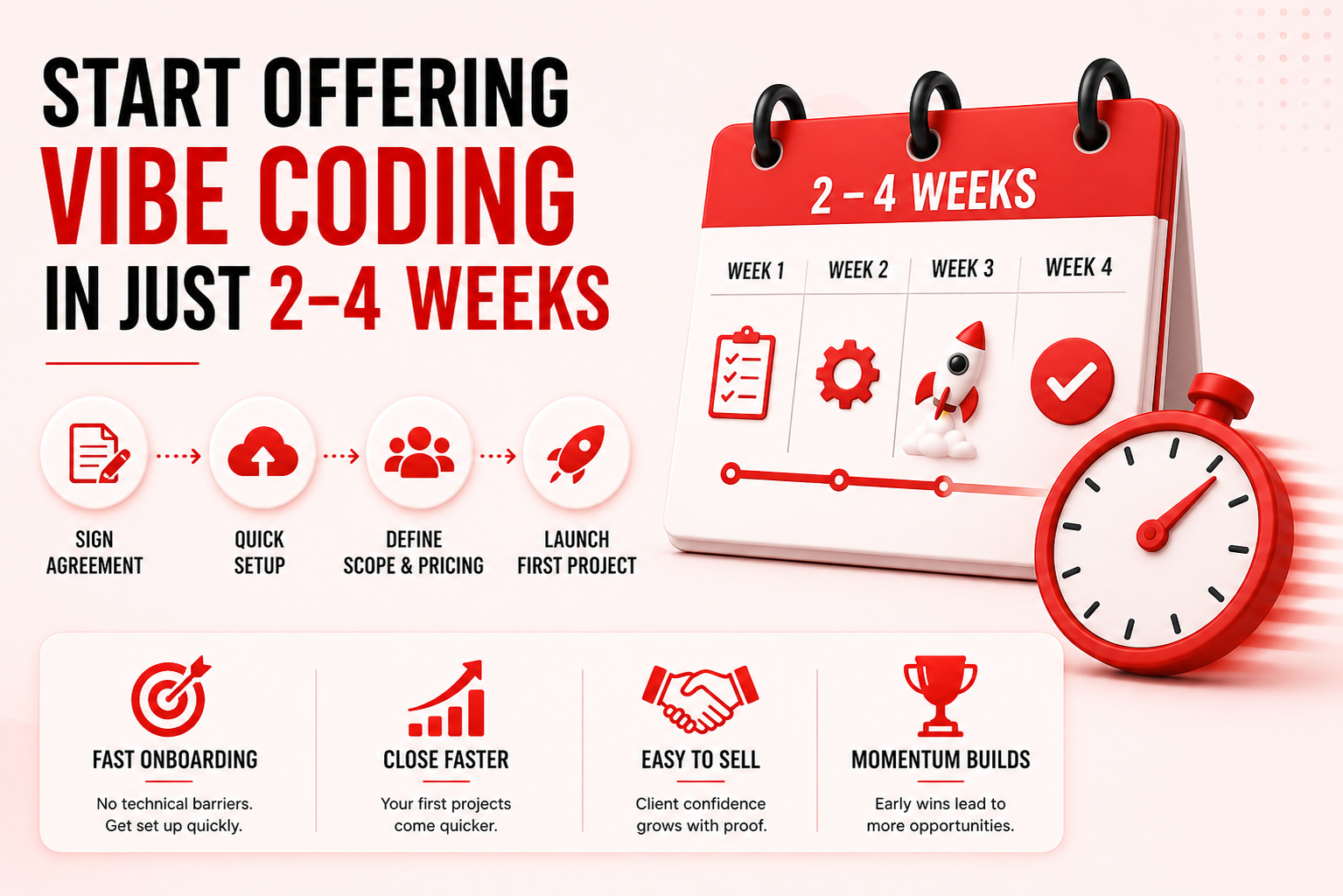
- Most US agencies can start offering vibe coding within two to four weeks of signing a partnership agreement, assuming contracts, staging environments, and communication protocols are set up efficiently.
- Where the time actually goes: mostly toward defining scope templates and pricing tiers — not technical onboarding, which tends to be the fastest part of the process.
- Agencies with an existing pipeline of client leads can sometimes start their first resold project within a week of finalizing partnership terms.
- ArixLabs onboards new reseller partners with pre-built contract templates and staging workflows specifically to compress this timeline, since agencies lose momentum the longer setup drags on.
- Momentum effect: agencies serious about scaling this offering typically see their first three projects close faster than expected once initial setup is done. Most report that sales conversations get noticeably easier once they have even one live client reference to point to.
- Realistic benchmark: getting from signed agreement to first live client project inside a month is achievable for most agencies entering this model for the first time.
- Whether starting with a single pilot or a full rollout, the fastest path in is a partnership program with clear onboarding already built.
FAQs
1. Is white label vibe coding a good business model for outfits, if you're shipping in the US?
Yes, for agencies with an existing client base and no in-house development team, white label vibe coding in the USA adds a new revenue line without hiring risk. It works best when the reselling agency treats delivery quality as its own responsibility, not the partner's alone.
2. What margin should a firm expect reselling vibe coding, if you're shipping in the US?
Most firms see 25 to 45 percent margin, depending on project complexity and whether strategy or support services are bundled in. Volume-based wholesale agreements set up through a proper vibe coding partnership program in the USA usually push margins toward the higher end over time.
3. Would it be reasonable for I fully rebrand a white label vibe coding partnership, if you're shipping in the US?
Yes, full rebranding is standard practice in white label vibe coding in the USA agreements, and most build partners expect their name to stay off client-facing materials entirely. The key is confirming this in the contract before the first project starts, not assuming it by default.
4. When you're shipping in the US, what's the catch with reselling vibe coding services?
The catch is that your brand absorbs the risk of your partner's delivery failures, so due diligence on shipping history matters more than the sales pitch before committing to any vibe coding for agencies who resell to clients in the USA arrangement. Agencies that skip this step tend to learn the hard way on their first missed deadline, which is why a short pilot project before a full rollout is worth the extra week it takes.
%20(1).jpg)

View more blogs
.png)
.png)


.png)

%20(1).png)
.png)
Ready to develop your own product? Get in touch today!
Get in Touch