



Introduction
Everyone thinks they have the next big social app idea. Fewer people realize that turning "wouldn't it be cool if" into a functioning platform with real-time feeds, notifications, and a comment section that doesn't collapse under load takes a very specific kind of team. If you're trying to hire social media app developers in the USA right now, you've probably already noticed the market is crowded with agencies claiming they can build "the next TikTok" in six weeks. Some of that is marketing noise. Some of it is real.
ArixLabs works from a simple principle: describe the feature you want in plain language, let AI tools generate a fast first draft of the interface and logic, then hand anything involving user data, media storage, or real-time interactions to engineers who actually stress-test it before it ships. That's the whole point of doing this properly. Speed where speed is harmless, human judgment where a bug could mean leaked messages or a feed that never loads. The team has shipped 100+ production apps across industries, which matters more than it sounds like it should when you're evaluating a social media app development company USA founders can actually rely on. Let's get into what that evaluation should look like.
1. What's the smartest way to find a top-rated vibe coding agency for your social media app in the US?
Start by asking for something specific: a live app, not a deck of slides. Anyone can design a beautiful mockup of a feed screen. Far fewer teams can show you a working comment system that updates in real time without freezing on a mid-range Android phone.
Here's a decent filter to run before you take any sales call seriously.
- Ask for a live product handling user-generated content, not a Figma prototype
- Ask who reviews AI-generated code before it reaches a real user
- Ask for one reference you can actually call, then call them
- Check whether the team has shipped anything involving media uploads, push notifications, or live feeds before
Broad experience is genuinely useful here. A firm that has only ever built social apps has seen one version of scale problems. A firm that has also shipped fintech, ecommerce, and messaging-heavy products has run into the same core issues, race conditions, media handling, notification fatigue, from several different angles. That range tends to make them faster at spotting trouble in your build before it becomes your users' problem. It's exactly the kind of thing to look for when you set out to hire social media app developers in the USA who won't need three months just to get comfortable with the domain.
2. What should a social app development team actually specialise in for American users?
It should specialise in the parts of a social platform that quietly separate a good app from a broken one: feed performance, media handling, notification logic, and content moderation tooling, since none of these are optional once real people start posting.
For a US-facing social media app, the essentials usually look like this:
- Efficient feed loading that doesn't choke on thousands of posts or heavy image content
- Reliable media upload and compression, since users will post everything from selfies to ten-minute videos
- Push notification systems that feel timely without becoming annoying enough to trigger mass uninstalls
- Basic content moderation hooks, even if the full moderation team comes later
- Authentication and privacy controls that respect how American users expect to manage who sees what
Ask any candidate team to walk through how they've handled each point on a real project. A team offering genuine social media app development company USA services should be able to name a specific decision they made, not just gesture vaguely at "scalability."
2.1 In-house team or outside agency for your US social app build?
An in-house team gives you long-term ownership and deep product memory, but hiring engineers who understand real-time feeds and media pipelines takes time, and the salaries don't pause while you wait. An outside agency gives you speed and a team that's already solved these problems before. Many social app founders launch with an agency, then build a small in-house team later once the product has found its footing and the codebase is genuinely maintainable. ArixLabs supports that path with clean handovers and documentation, so the switch doesn't turn into a rebuild.
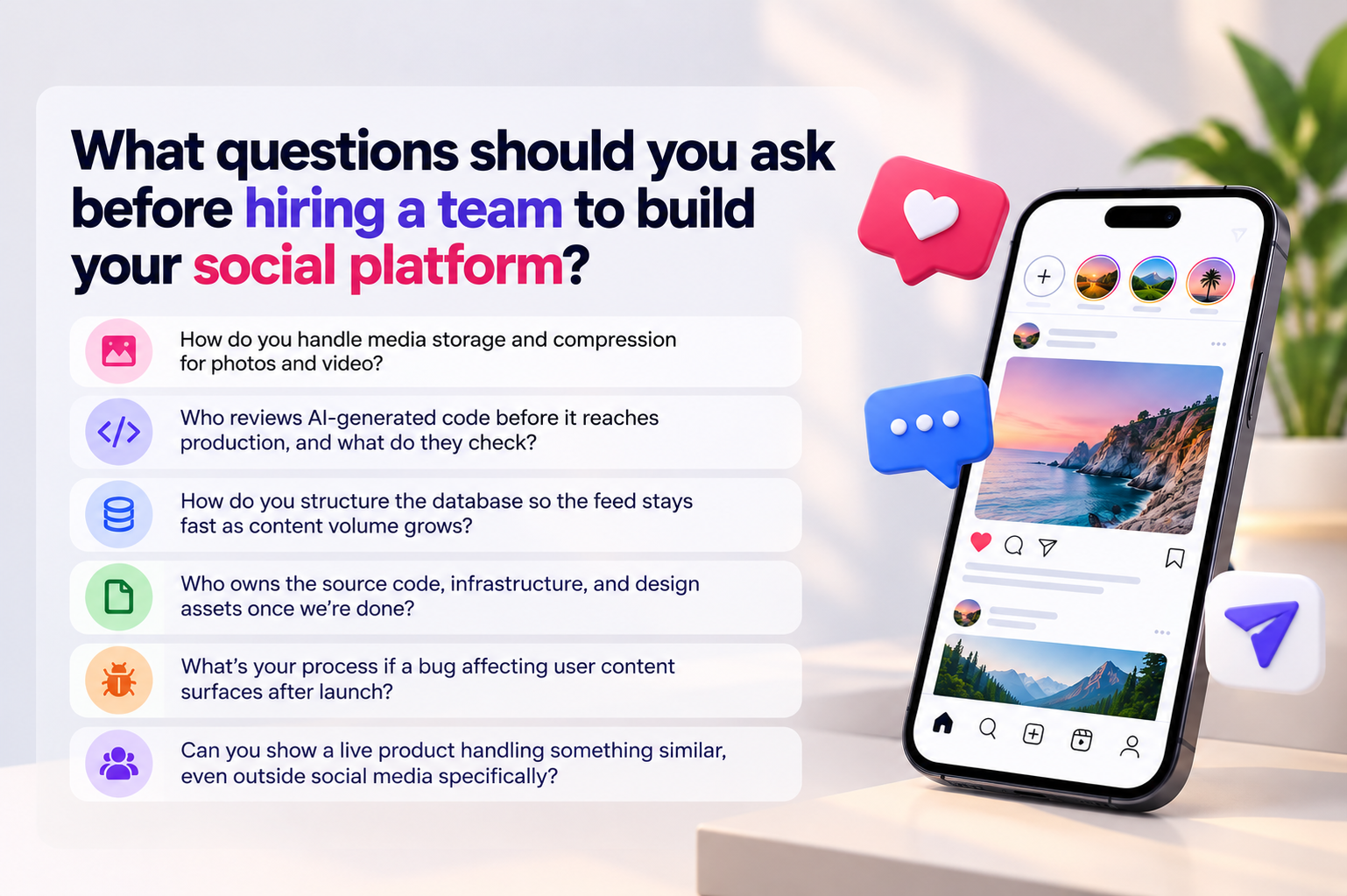
3. What questions should you ask before hiring a team to build your social platform?
Ask questions that expose real process, not confidence. A polished sales call tells you nothing about whether a team has ever handled a feed that needs to update for thousands of users simultaneously.
Bring this list into every conversation.
- How do you handle media storage and compression for photos and video?
- Who reviews AI-generated code before it reaches production, and what do they check?
- How do you structure the database so the feed stays fast as content volume grows?
- Who owns the source code, infrastructure, and design assets once we're done?
- What's your process if a bug affecting user content surfaces after launch?
- Can you show a live product handling something similar, even outside social media specifically?
That last one matters more than people expect. A team with genuine range across industries can usually show you something adjacent, a messaging feature, a media-heavy ecommerce catalogue, that reveals just as much about their capability as a thin, social-only portfolio would.
4. How do you properly evaluate a vibe coding agency's social app portfolio?
Use the product yourself before taking anyone's word for it. Sign up, post something, upload a photo, try to break the feed, and see what actually happens. A case study page full of screenshots tells you what the app looked like once. Actually clicking through it tells you whether it still holds up.
Check how the feed behaves when you scroll fast, whether media uploads compress sensibly or take forever, whether push notifications feel considered rather than spammy, and how consistent the whole experience feels from screen to screen.
4.1 What are the signs of a genuinely solid social app development partner?
Solid partners show repeat clients, name the actual engineers who worked on a build, and are willing to talk through something that went wrong and how they fixed it. They've usually shipped across more than one industry too, which is worth treating as a strength rather than a red flag, since it means they've been tested against a wider spread of real-world problems than a social-only shop typically encounters.
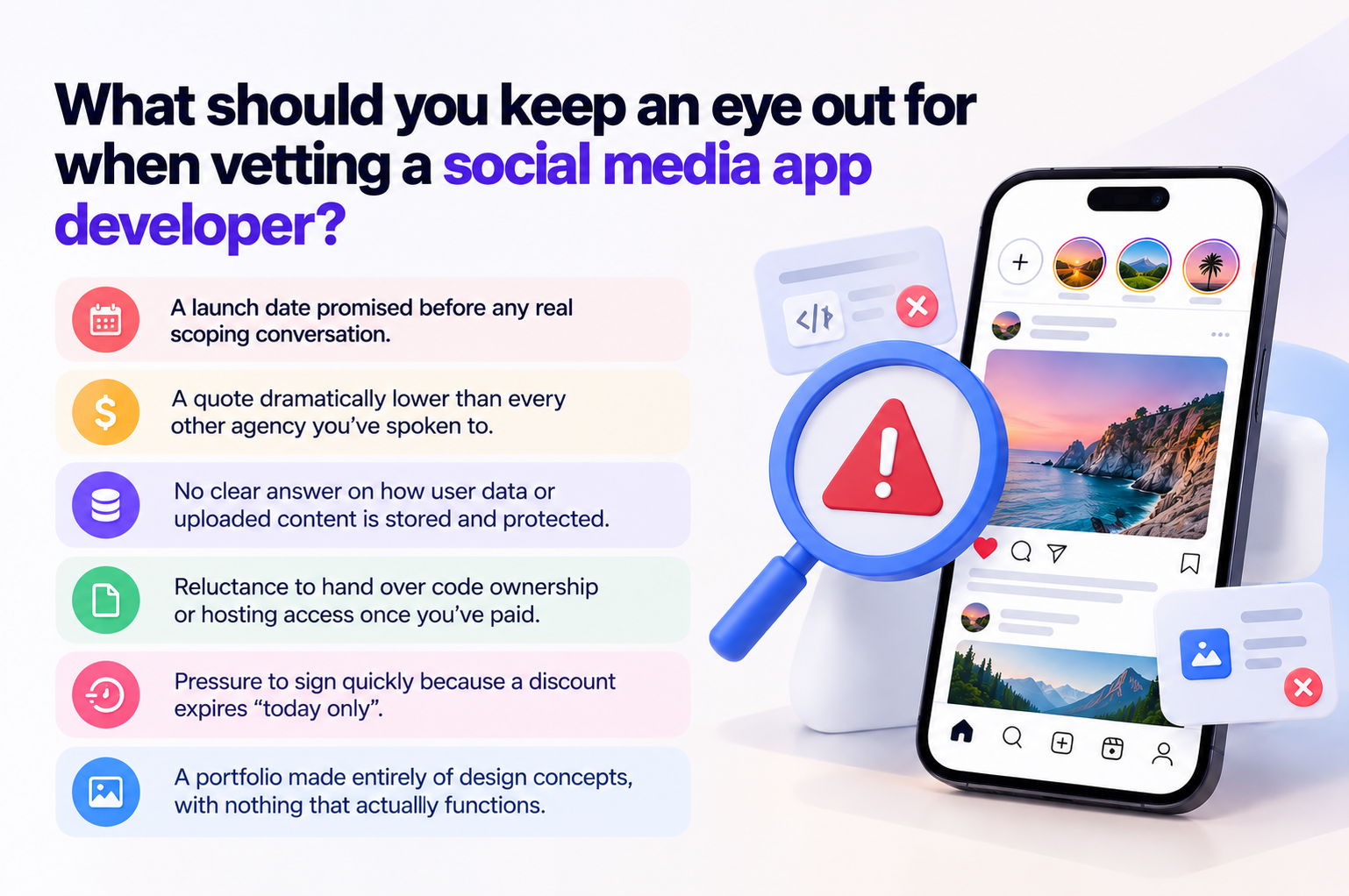
5. What should you keep an eye out for when vetting a social media app developer?
Watch for vagueness dressed up as confidence, since that's the most common warning sign by a wide margin. If a team can't explain how they'll handle media storage costs at scale, or who reviews AI-generated code before release, assume that same fog covers the rest of the project too.
- A launch date promised before any real scoping conversation
- A quote dramatically lower than every other agency you've spoken to
- No clear answer on how user data or uploaded content is stored and protected
- Reluctance to hand over code ownership or hosting access once you've paid
- Pressure to sign quickly because a discount expires "today only"
- A portfolio made entirely of design concepts, with nothing that actually functions
5.1 What should a strong project pitch for a social media app include?
A strong pitch lays out a clear feature list tied to milestones, names the actual people doing the work, includes a real testing plan for feed performance and media handling specifically, and prices everything in phases rather than one lump sum. A pitch that treats testing as an afterthought is quietly telling you how seriously that team treats testing once the contract is signed.
5.2 How much does communication style actually affect a social app's success?
More than most founders expect walking in. Social apps involve constant small decisions, how a notification is worded, how a feed algorithm prioritises content, and a slow-communicating team turns every one of those decisions into a week-long delay. Look for weekly demos, a shared task board, and a named contact who can answer directly instead of routing every question through someone who has to go check with someone else.
6. Is it worth hiring a niche social app specialist over a broader development team?
Here's where the specialist pitch sounds convincing until you actually test it. A firm that has only ever built social apps has only ever seen social app problems, in roughly the same shape every time. A genuinely capable all-rounder team has run into the same core issues, real-time data, media handling, user trust, notification fatigue, across fintech, healthcare, and ecommerce builds, and that usually makes them quicker to spot trouble before it ships, not slower.
What actually matters isn't how narrow a firm's client list looks on a homepage. It's whether the same rigor gets applied to every project, social media or otherwise. A team offering broad, proven capability, the kind ArixLabs has built across 100+ shipped apps, tends to bring sharper instincts to a social platform than a shop that's only ever seen one flavour of the problem.
7. What does building a social media app with a vibe coding team usually cost?
Cost tracks scope and complexity far more than it tracks the vibe coding method itself. A simple photo-sharing app with basic profiles costs a fraction of a full platform with live video, algorithmic feeds, and built-in messaging. Treat any flat number quoted before proper scoping as a rough guess, not a real quote.
Most agencies price one of three ways: fixed price for a clearly scoped build, time and materials for evolving requirements, or a monthly retainer for ongoing feature work. Vibe coding tends to shorten the time spent on first drafts of screens and standard flows, which can lower overall cost somewhat, but testing feed performance and media handling under real load should never be the corner anyone cuts to hit a number.
Ask every team you're considering to break their quote down feature by feature, so you can see what the real-time and media-heavy work costs separately from the standard interface build. ArixLabs prices in phases tied to specific deliverables, which tends to separate agencies that are confident in their own estimate from ones hoping you won't ask too many follow-up questions.
Conclusion
Building a social media app isn't really about finding a team that has only ever built social apps. It's about finding one that treats feed performance, media handling, and user trust with the seriousness a platform full of real people's content actually deserves. Ask sharp questions, use the product yourself before committing, and favour the team that shows its work instead of just its confidence. If you're currently trying to hire vibe coding developers for social apps in US markets, or comparing options among a social media app development company USA founders recommend to each other, that habit of proof over promises is worth checking for yourself before you sign anything.
FAQ
1. How do I pick the right team to build my social media app?
Shortlist agencies with checkable, working products, ask each one the same process questions, and compare how specifically they answer. Pick the team that names actual people, methods, and examples rather than general reassurance.
2. What separates a good social app developer from an average one?
A disciplined approach to feed performance and media handling, genuine human review of AI-generated code before it ships, and enough range from other industries to catch problems a social-only shop might miss entirely.
3. Does a developer need prior social media experience to build mine well?
It helps, but broad experience with real-time systems, media storage, and user data across other industries often counts for just as much, since the underlying technical challenges overlap heavily.
4. How long does onboarding a social app development team usually take?
Typically one to two weeks for access, scoping, and planning, a little longer if the app involves more complex features like live video or algorithmic feed personalisation that need mapping out early.
%20(1).jpg)

View more blogs




.png)

_a_change__2025__to__20.png)
.png)
.jpg)
Ready to develop your own product? Get in touch today!
Get in Touch