



1. Introduction
Ask ten bankers whether vibe coding belongs in a bank and you will hear two answers: never, and why not? Both are partly right. Banks run on trust, audits and ledgers that must balance to the cent, yet most of what a customer touches is interface, workflow and reporting, the layers where AI-assisted development is strongest. The useful question is not whether to use it but where, and who should steer it. This guide cuts through the common myths for US banks, credit unions and fintech founders who want to hire vibe coders for banking software without creating a regulatory problem.
ArixLabs builds software with vibe coding, with senior engineers reviewing every AI-drafted change, from a base in Jaipur with 100+ production apps delivered. Our view of digital banking app development with vibe coding is simple: use the speed on the layers around the core, keep the ledger with systems built for it, and choose a vibe coding agency for banking apps that can explain its controls in writing.
2. Can vibe coding be used for banking software?
Myth: banks cannot touch AI-assisted code. Reality: they can, because US regulators judge risk management and outcomes, not the tool that typed the code. A bank using vibe coding must still meet the same expectations for secure development, change control, testing and vendor oversight that apply to any software. Done properly, digital banking app development with vibe coding gives teams working screens in days and lets compliance staff react to something real instead of a specification. Anyone planning to hire vibe coders for banking software should treat the AI as a fast drafter whose output always passes human review, and any vibe coding agency for banking apps should describe that review before you see a demo.
2.1 Where does vibe coding fit inside a bank's technology stack?
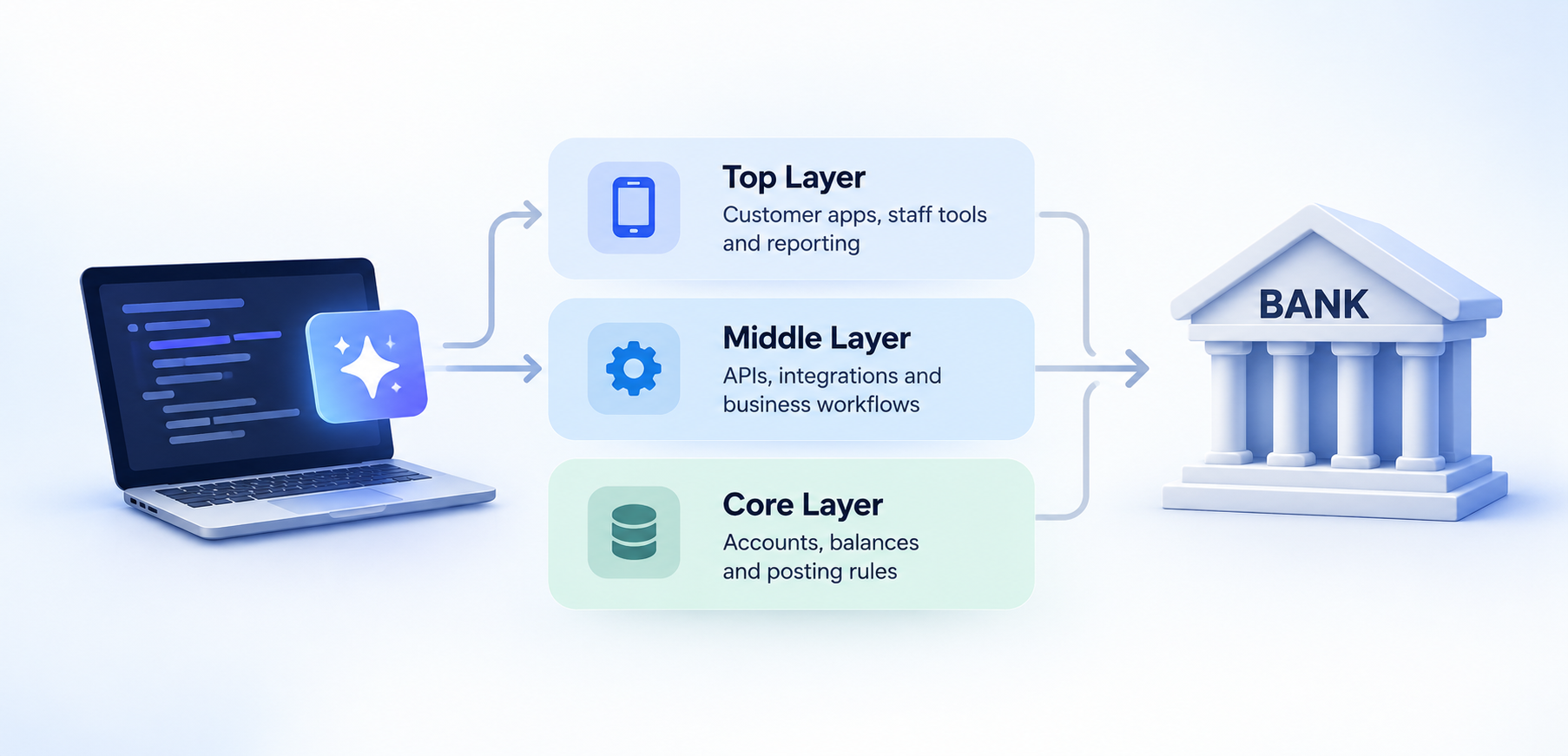
Think of three layers. The core holds accounts, balances and posting rules, and stays with systems built for it. The middle layer holds APIs, integrations and business workflows. The top layer holds customer apps, staff tools and reporting. Vibe coding earns its keep on the top layer, helps with the middle under tight review and stays away from the core. That is the shape of sensible digital banking app development with vibe coding.
2.2 What does a safe vibe coding workflow look like in a bank?
The AI drafts, tests come first and a named engineer approves every pull request. Code runs in a sandbox against synthetic data, changes ship through the bank's normal approval path and every release leaves an audit trail. Real customer data never enters a prompt. That workflow is what separates professional digital banking app development with vibe coding from a weekend demo, and a good vibe coding agency for banking apps will walk you through it before you hire vibe coders for banking software for a regulated project.
3. What parts of banking software are best for vibe coding?
Myth: it is all or nothing. Reality: the best parts are customer-facing screens, onboarding journeys, account dashboards, notification flows, document upload and back-office tools, because errors there are visible and cheap to reverse. The worst candidates are posting logic, interest and fee calculation, reconciliation and anything that decides whether money moves. A team about to hire vibe coders for banking software should hear that list from the agency unprompted. Any vibe coding agency for banking apps that offers to rewrite your ledger in a fortnight is selling the wrong thing.
3.1 Can vibe coders build internal banking dashboards?
Yes, and they are the safest first project. Dashboards for loan pipelines, KYC review queues, branch performance or complaint tracking let your staff test the approach with little customer exposure. Start read-only against masked or replicated data, apply role-based access and log every query. If the pilot goes well, you have evidence for the board and for examiners before touching member-facing money flows. Banks that hire vibe coders for banking software often begin here for that reason.
3.2 Can vibe coders build mobile banking apps?
Yes, for the front end. Account views, card controls, notifications, biometric sign-in and document capture are well suited to vibe coding, and one codebase can serve iOS and Android. The sensitive parts remain server-side: authorisation, limits and posting. Ask your vibe coding agency for banking apps how it handles app store review, certificate pinning and jailbreak detection, since mobile digital banking app development with vibe coding fails quietly when those basics are skipped.
4. How much does a custom banking app cost?
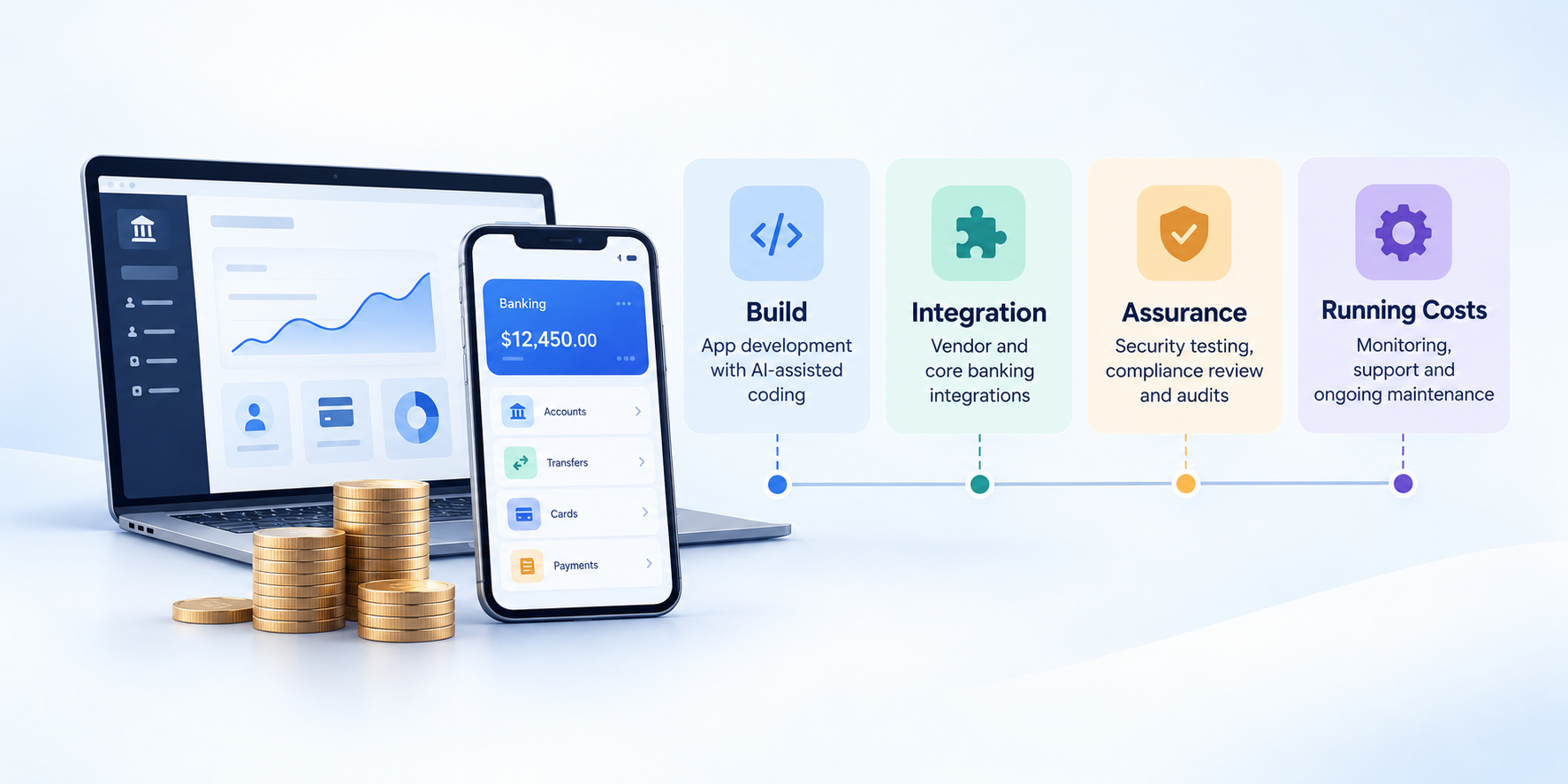
Myth: AI makes custom banking apps cheap. Reality: it makes the interface cheap, and the rest stays expensive. A read-only portal or internal tool typically costs a fraction of a traditional build, while money movement, core integration, independent testing and compliance review push the total towards six figures and beyond. Budget separately for vendor integration fees, security testing, monitoring and support. When you hire vibe coders for banking software, ask for a quote split between build, integration, assurance and running costs, and distrust a vibe coding agency for banking apps that prices compliance as an afterthought. Honest digital banking app development with vibe coding pricing shows where AI saves and where it cannot.
4.1 What costs surprise banks?
Vendor integration fees, penetration tests, accessibility audits, ongoing monitoring, examiner-ready documentation and cyber insurance usually sit outside the first quote. Ask a vibe coding agency for banking apps to list them, and make that list a condition when you hire vibe coders for banking software.
4.2 How long does a digital banking MVP take?
A read-only front end can reach a working demo in weeks. A pilot connected to a core takes longer, since vendor onboarding, security review, change-management cycles and board approvals run on their own calendars. Plan the integration paperwork alongside the build, and pilot with employees before customers. Ask any vibe coding agency for banking apps to show a plan with those dependencies drawn separately.
5. Can vibe coders connect to a core banking system?
Myth: the core is a locked box nobody can connect to. Reality: modern cores expose APIs and connecting through them is routine, but access is controlled by the core provider. Vendors such as Fiserv, Jack Henry and FIS run partner programmes and approval processes, so expect credentials, sandbox access and certification steps before you touch live data. Vibe coders can build the front end and integration layer against documented APIs, but the logic must be tested against the core's real behaviour: timeouts, batch windows, holds and reversals.
Before you hire vibe coders for banking software, ask which cores the team has connected to. A vibe coding agency for banking apps with no answer is still learning on your project, and digital banking app development with vibe coding should not be where that learning gets paid for.
5.1 What should an integration layer never do?
It should never be the system of record, never retry a payment blindly and never trust data from the client. Treat the core as the source of truth, use idempotency controls and reconcile every day. Strong digital banking app development with vibe coding teams build this discipline into the first sprint.
6. What compliance rules apply to US banking apps?
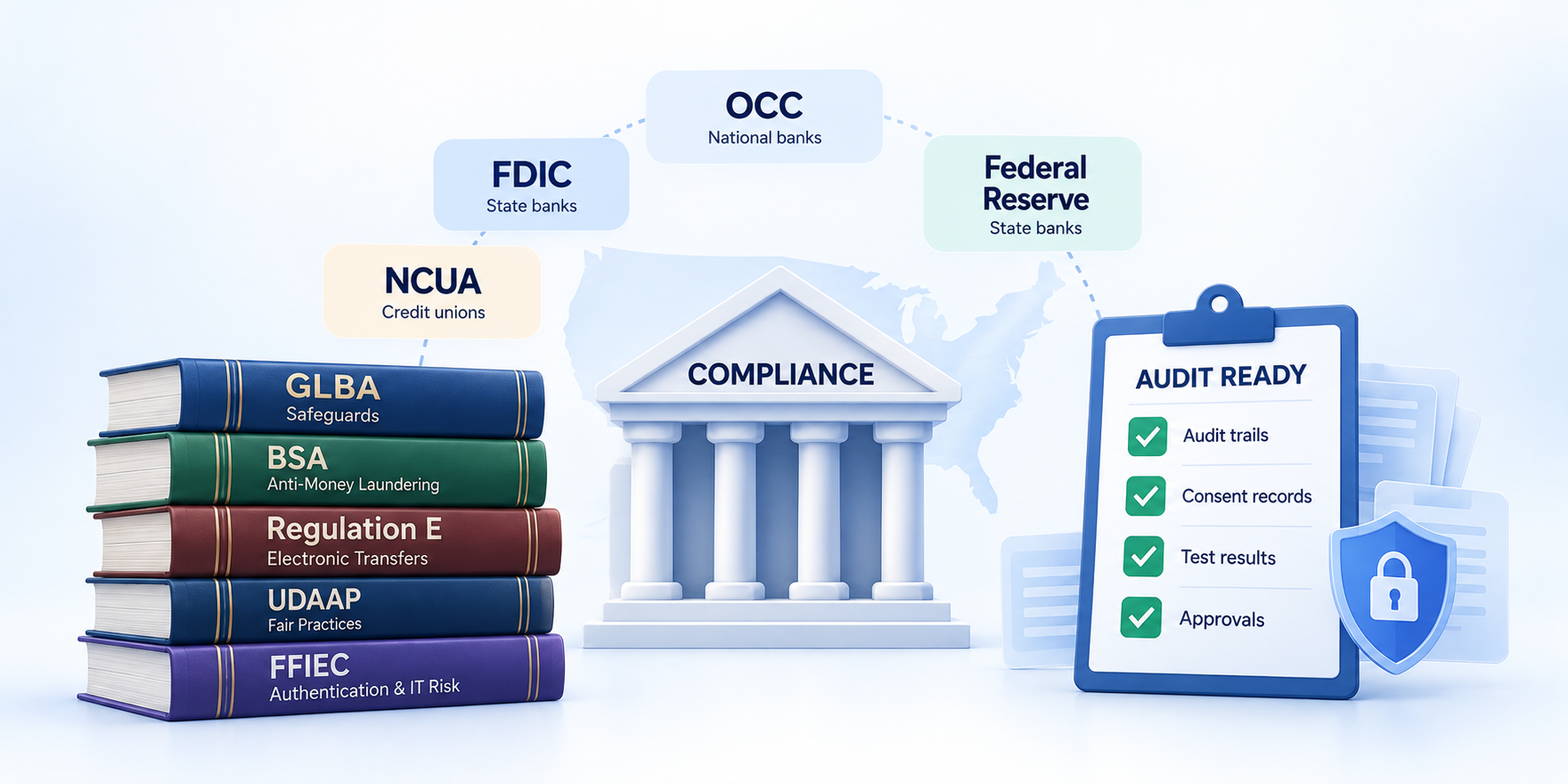
Myth: there is one banking rulebook. Reality: it depends on your charter and regulator. National banks answer to the OCC, state banks to the FDIC or the Federal Reserve and state agencies, and credit unions to the NCUA, while fintechs partnering with banks inherit the bank's expectations. Common themes include Gramm-Leach-Bliley safeguards, Bank Secrecy Act duties, Regulation E for electronic transfers, UDAAP rules against unfair or deceptive practices, fair lending and FFIEC guidance on authentication and IT risk.
Bring compliance officers in before design starts. A vibe coding agency for banking apps cannot give legal advice, but it can build audit trails, consent records and disclosures into digital banking app development with vibe coding from day one, and anyone about to hire vibe coders for banking software should ask for examples.
6.1 How do I manage vendor risk when hiring an agency?
US regulators expect banks to run due diligence, contracting and ongoing monitoring for third parties, under interagency guidance finalised in 2023. In practice, ask for security attestations, review financials and insurance, check subcontractors and data locations, and write audit rights, incident notice, termination and exit support into the contract. Some technology service relationships also need notice to regulators. Because AI tools are a new subcontractor layer, ask which tools the agency uses and where code and prompts go. Do this before you hire vibe coders for banking software, and again each year.
6.2 How do you keep audit evidence from AI-assisted development?
Store pull request histories, test results, scan reports and approvals alongside a record of which changes were AI-drafted. Keep it organised by release so an examiner can follow one change from request to production. Teams practising digital banking app development with vibe coding should produce this evidence as a by-product of normal work, not as a scramble before an audit.
7. How do you build a customer portal for a credit union?
Myth: credit unions need a giant digital platform. Reality: many need a focused portal that does a few things well. Start with member sign-in, account and loan views, transaction search, secure messaging, document upload and card controls, then add transfers and bill pay once the basics are stable. Use the core's APIs, keep sensitive actions behind step-up authentication and design for accessibility and older devices.
Credit unions can also buy a digital banking platform and add vibe-coded modules around it, such as loan applications or onboarding. The NCUA has historically lacked direct authority over most credit union vendors, so your own due diligence matters even more. A vibe coding agency for banking apps that understands credit unions will propose phases, not a big bang, and will show how digital banking app development with vibe coding gets member feedback sooner. If you plan to hire vibe coders for banking software for a credit union, ask for a phased roadmap.
7.1 What should a credit union pilot include?
Start with staff and a few friendly members, limit transaction types and review every exception by hand. Agree success measures in advance, such as login success, support tickets and task completion. That pilot is where digital banking app development with vibe coding proves its worth, and a reason to hire vibe coders for banking software in phases rather than all at once.
8. Is AI-generated code acceptable for regulated banks?
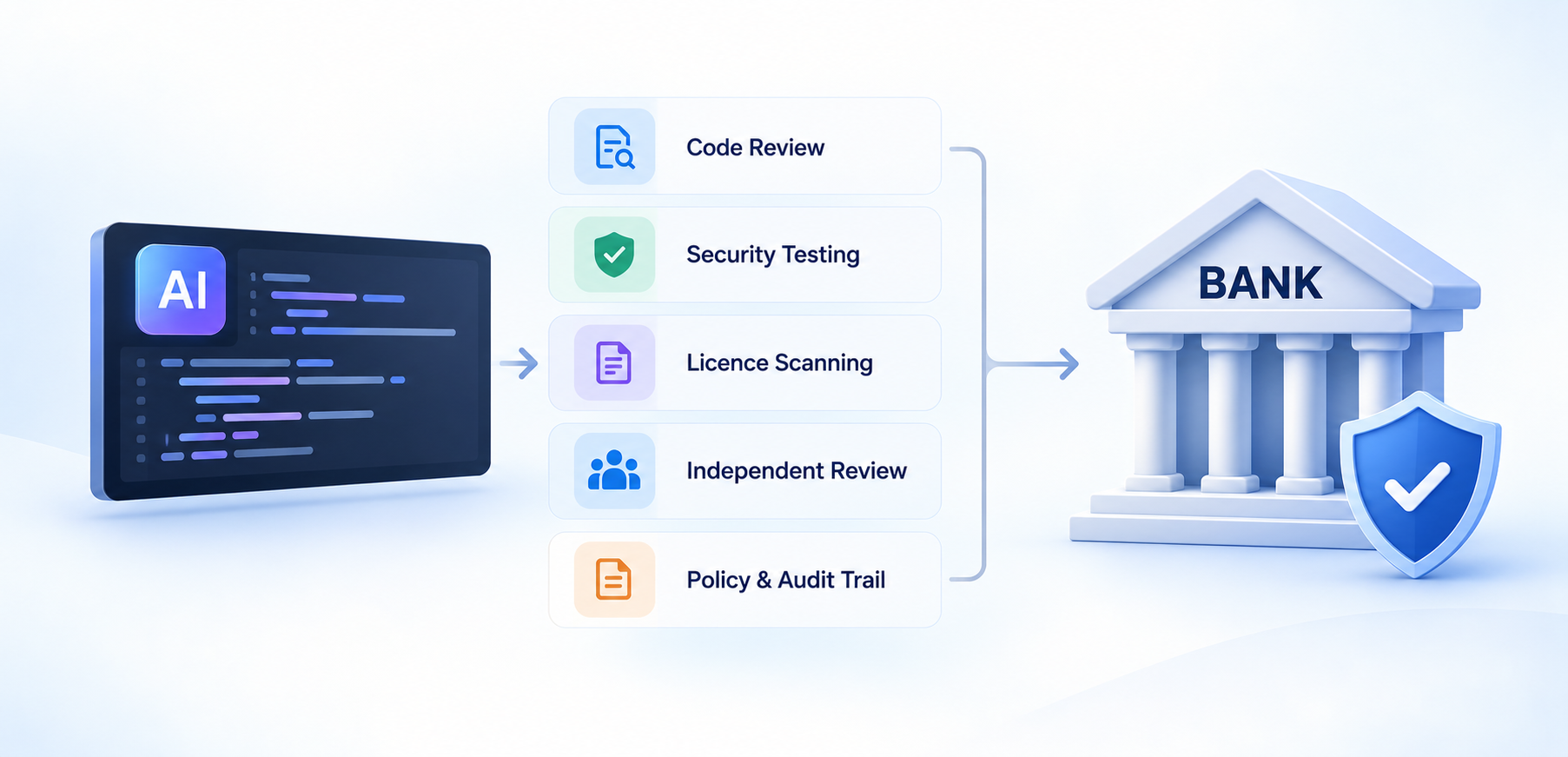
Myth: regulators ban it. Reality: no US banking regulator bans AI-generated code, but they expect the bank to own the outcome. Examiners will ask about your secure development lifecycle: how code is reviewed, tested, approved and deployed, who can change production and how you track open-source licences. AI adds specific questions: whether prompts contain confidential data, whether generated code copies licensed material and whether review catches subtle flaws. Keep an AI-use policy, record which changes were AI-drafted, require independent review and run static and dynamic scans.
A vibe coding agency for banking apps should show you that policy before you hire vibe coders for banking software. Mature digital banking app development with vibe coding treats AI as a tool inside controls, never a replacement for them.
8.1 What security checks are needed before launch?
At minimum: threat modelling, static and dynamic code analysis, dependency and licence scanning, secrets scanning, an independent penetration test, cloud configuration review, resilience and disaster recovery testing, access reviews and an accessibility audit. Fix critical findings before launch, retest and keep the evidence for examiners. A serious vibe coding agency for banking apps will have run this checklist on earlier projects.
9. Conclusion
Vibe coding does not change what banking demands: control, evidence and accountability. It changes how fast you can reach a testable product on the layers where speed is safe. Keep the core with the systems built for it, put every AI-drafted change through human review and involve compliance early. That is how digital banking app development with vibe coding becomes something examiners can accept. When you hire vibe coders for banking software, judge them on controls rather than demos, and choose a vibe coding agency for banking apps that welcomes the scrutiny.
10. Frequently Asked Questions
What is the best tech stack for a banking app?
The best stack is the one your security team can support: a typed backend language, a relational database, an API gateway, managed encryption keys, strong observability and a web or mobile front end such as React or Flutter. Stability and auditability matter more than novelty, even in digital banking app development with vibe coding.
How do I add two-factor authentication to a banking app?
Use passkeys or authenticator apps first, push approvals second and SMS only as a fallback. Add device binding and risk-based step-up for sensitive actions, and secure account recovery, which attackers target first.
Should I build a banking app or buy white-label?
Buy when speed and compliance coverage matter most, build when the experience is your differentiator, and combine the two when you can: a white-label base with custom modules around it, which a vibe coding agency for banking apps can build.
How does ArixLabs approach banking projects?
ArixLabs works on the layers around the core, such as portals, mobile front ends and staff tools, using vibe coding with senior review on every change. We map the integration boundary first, keep ledger logic with the core vendor and hand you code you own. If you want to hire vibe coders for banking software, we show our review process before you commit.
%20(1).jpg)

View more blogs
.jpg)
.png)

.png)
.png)

.png)
Ready to develop your own product? Get in touch today!
Get in Touch