



1. Introduction
Most marketplace cost guides give you one number and a shrug. This one tears the budget apart line by line, so you can see where the money goes, which lines vibe coding shrinks and which it cannot touch. If you plan to hire vibe coders for multi-vendor marketplace work, that breakdown is the difference between a quote you understand and a quote you hope is right.
ArixLabs builds with vibe coding, with senior engineers reviewing every AI-drafted change, from a base in Jaipur with 100+ production apps delivered. We treat a vibe coding marketplace app in USA as a payments and trust problem first and a screens problem second, and we expect any multi-vendor marketplace development agency to explain its budget the same way.
2. Can vibe coding build a multi-vendor marketplace?
Yes, with a clear split of labour. A marketplace has three apps in one: a buyer experience, a vendor dashboard and an admin console. Vibe coding drafts those interfaces fast, so a clickable version can exist within days. What it cannot shortcut is the money layer, where payouts, fees and refunds must balance to the cent. A vibe coding marketplace app in USA works when AI drafts the screens and engineers own the payments, permissions and data model. Before you hire vibe coders for multi-vendor marketplace work, ask which of those three apps the team has shipped before.
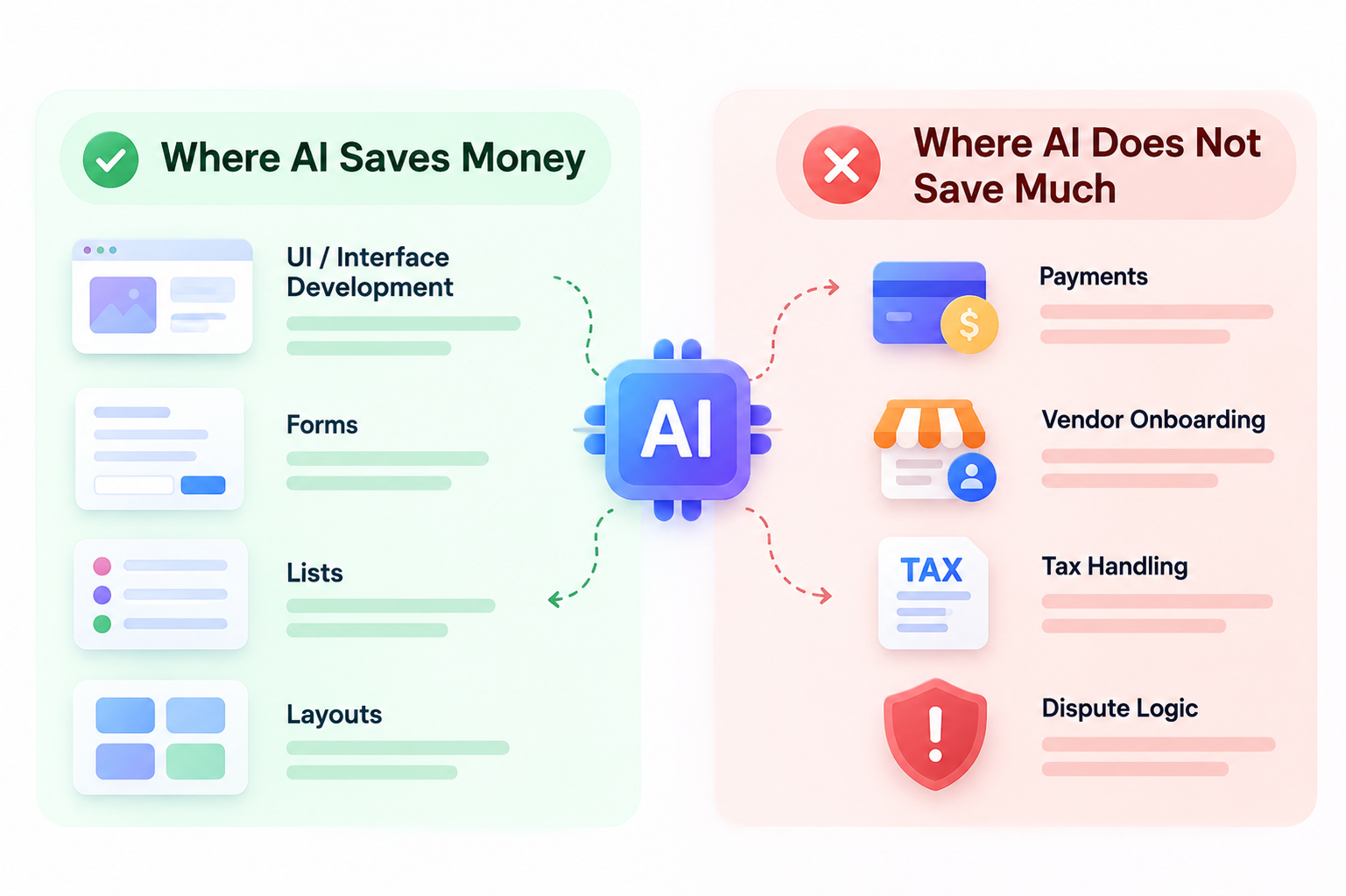
2.1 Where does the AI save money, and where not?
Interface work shrinks the most, because layouts, forms and lists are repetitive. Payments, vendor onboarding, tax handling and dispute logic shrink the least, because they depend on partner approvals and careful testing. Any multi-vendor marketplace development agency should show you its budget split by those categories, and a vibe coding marketplace app in USA should come with that split attached.
2.2 What should the first prototype show?
Three things: a buyer finding a product from two different vendors, a vendor adding a listing and seeing an order, and an admin approving a vendor. It should run on synthetic data and prove the flow, not the security. A strong multi-vendor marketplace development agency delivers it in about two weeks, and it is the cheapest way to test whether to hire vibe coders for multi-vendor marketplace work at full scale.
3. What does a marketplace MVP cost in the US?
A focused marketplace MVP built with vibe coders typically costs well below a traditional build, and the range is wide because scope drives everything. Here is the teardown most projects follow:
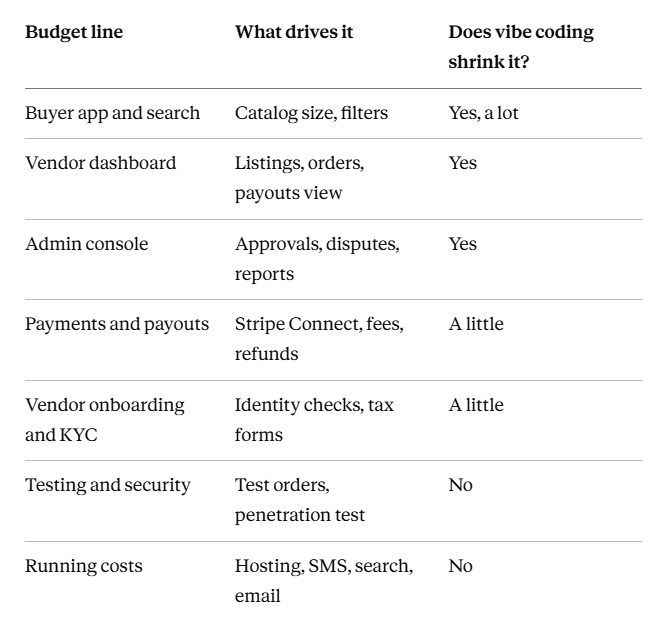
Ask each supplier for a quote in this shape, and compare lines rather than totals. A multi-vendor marketplace development agency that quotes one lump sum is hiding the lines that matter. When you hire vibe coders for multi-vendor marketplace work from several firms, the cheapest total often means someone priced the payments line at zero.
3.1 What costs sit outside the build quote?
Stripe fees, identity verification charges, sales tax software, a search provider, push and email tools, app store accounts, support software and legal review of your marketplace terms. Budget them monthly before launch.
3.2 How should you budget a pilot?
Fund a two-week prototype, a month of build for the riskiest app, a testing buffer and three months of running costs, then hold a contingency for partner changes. Agree scope in writing before you hire vibe coders for multi-vendor marketplace work, so extra requests do not quietly become extra invoices. A sensible vibe coding marketplace app in USA plan leaves room for surprises.
4. How do vendor payouts work with Stripe Connect?
Stripe Connect lets the marketplace take a customer's payment, keep its fee and send the rest to the vendor, with Stripe handling vendor onboarding and identity checks. You choose an account type: Express accounts give vendors a Stripe-hosted onboarding and dashboard, which suits most marketplaces, while Custom accounts give you full control and full responsibility. Payments can use destination charges, where funds go to the vendor with your fee deducted, or separate charges and transfers when one order pays several vendors.
The details are where a vibe coding marketplace app in USA needs human care. Confirm payments with server-side webhooks, use idempotency keys on every request, never trust amounts sent from the app and plan for failed payouts and negative balances. Test refunds that reverse a transfer. A multi-vendor marketplace development agency should have shipped this before, since vibe coding marketplace app in USA projects live or die on payouts, and you should ask to see it before you hire vibe coders for multi-vendor marketplace work.
4.1 How do commissions and fees get calculated in the app?
Store the fee rule as data, not code: a percentage, a flat fee or a tiered rate per category or vendor. Calculate it on the server when the order is placed, record it on the order line and never recalculate later, so reports always match payouts. Decide who bears processing fees, and show vendors a clear statement of every deduction. Money logic like this is where a vibe coding marketplace app in USA should lean on tests, not trust.
4.2 What should you test before real money moves?
Failed payouts, partial refunds, a vendor with a negative balance, a cart with items from three vendors, duplicate taps and a dropped connection mid-payment. Run each in test mode, then place one small live order. Ask any multi-vendor marketplace development agency for its test checklist before you hire vibe coders for multi-vendor marketplace work on payments.
5. What features do buyers, vendors and admins each need?
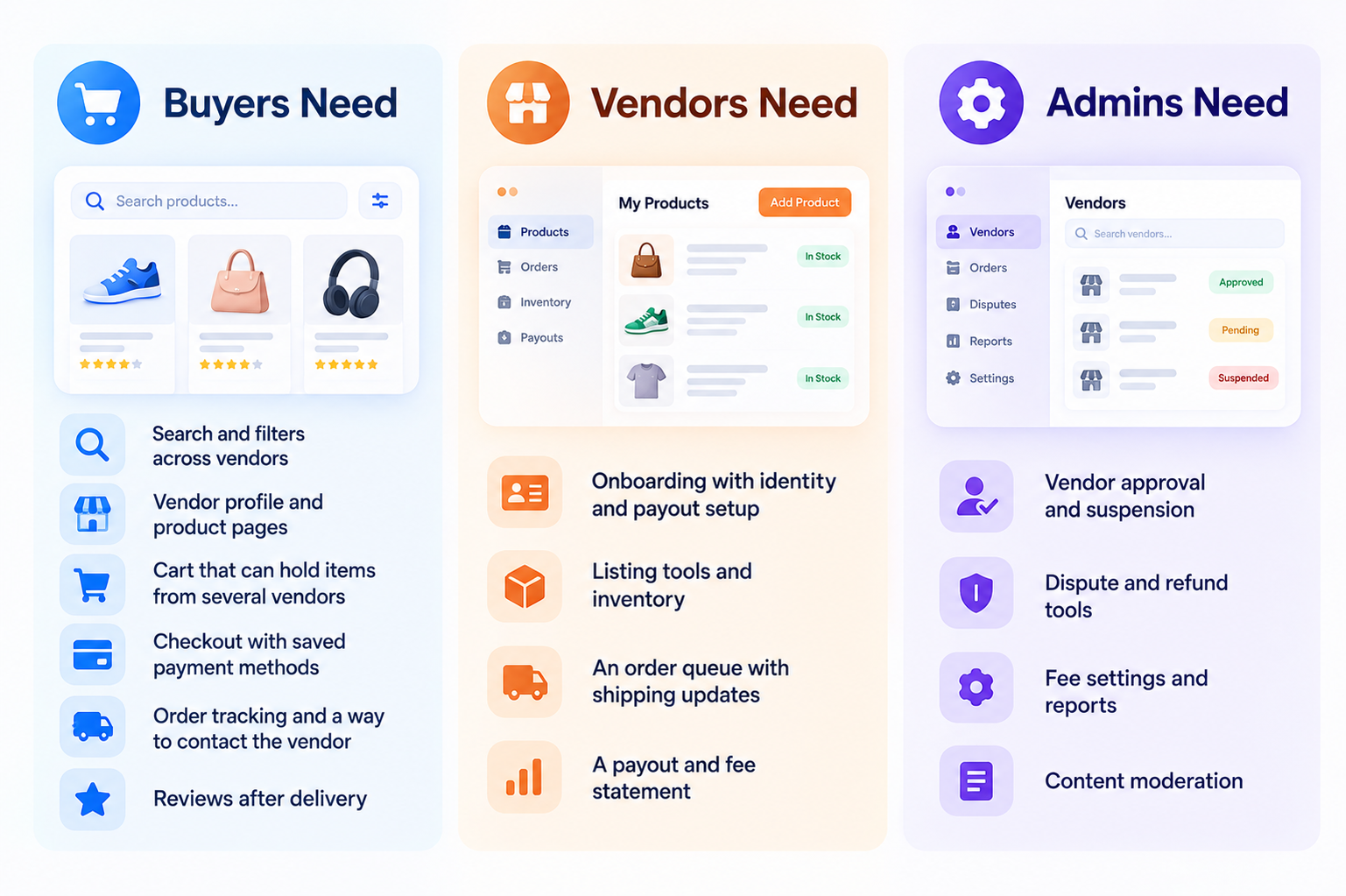
Keep version one to what lets a stranger buy from a stranger safely.
Buyers need:
- Search and filters across vendors
- Vendor profile and product pages
- Cart that can hold items from several vendors
- Checkout with saved payment methods
- Order tracking and a way to contact the vendor
- Reviews after delivery
Vendors need:
- Onboarding with identity and payout setup
- Listing tools and inventory
- An order queue with shipping updates
- A payout and fee statement
Admins need:
- Vendor approval and suspension
- Dispute and refund tools
- Fee settings and reports
- Content moderation
Leave referral schemes, vendor ads and AI recommendations for version two. Teams that hire vibe coders for multi-vendor marketplace work without a cut-list usually overspend, and a disciplined multi-vendor marketplace development agency will say no to early extras, because a vibe coding marketplace app in USA makes adding them dangerously easy.
5.1 How do I handle disputes, refunds and reviews?
Give every order a dispute state, a time window and an evidence trail of messages, tracking and photos. Decide who pays for refunds, the vendor or the marketplace, and write that into vendor terms. Reviews should come only from verified buyers, with a way for vendors to respond. Build the admin tools for this before launch, since the first dispute usually arrives in week one.
5.2 What does vendor onboarding look like?
A vendor signs up, completes Stripe's identity and bank steps, accepts your terms, adds a first listing and waits for approval. Make it short, because every extra step loses vendors you worked hard to recruit. This is where a vibe coding marketplace app in USA wins or loses its first month, and a good multi-vendor marketplace development agency will show you the drop-off at each step.
6. How long does it take to build a marketplace app?
A focused MVP typically takes weeks rather than months, and the calendar is set by approvals more than by code. Payment platform review, vendor identity flows, tax setup and app store review all run on other people's schedules, so start them in week one. A sensible sequence is discovery, prototype, build sprints for each of the three apps, test orders across several vendors, then a soft launch. Any multi-vendor marketplace development agency should show those external steps as separate lines, and a vibe coding marketplace app in USA can finish its screens long before the last approval lands.
6.1 What does a realistic first quarter look like?
Weeks one and two bring the prototype and the payment application. Weeks three to six bring the three apps and payouts. Weeks seven and eight bring test orders and fixes. Weeks nine to twelve bring a soft launch with a small group of vendors. Founders who hire vibe coders for multi-vendor marketplace work should expect this rhythm, and a vibe coding marketplace app in USA fits inside it.
6.2 Can a vibe-coded marketplace scale to thousands of vendors?
Yes, if the foundation is sound. Scaling pain comes from search, image storage, payout batches and admin tools, not from the interface. Use a proper relational database, a dedicated search service, a CDN for images, background queues for payouts and notifications, and monitoring from the start. Rewriting later is costly, so ask a multi-vendor marketplace development agency how it would handle ten thousand listings before you hire vibe coders for multi-vendor marketplace work.
7. How do I solve the chicken-and-egg problem at launch?
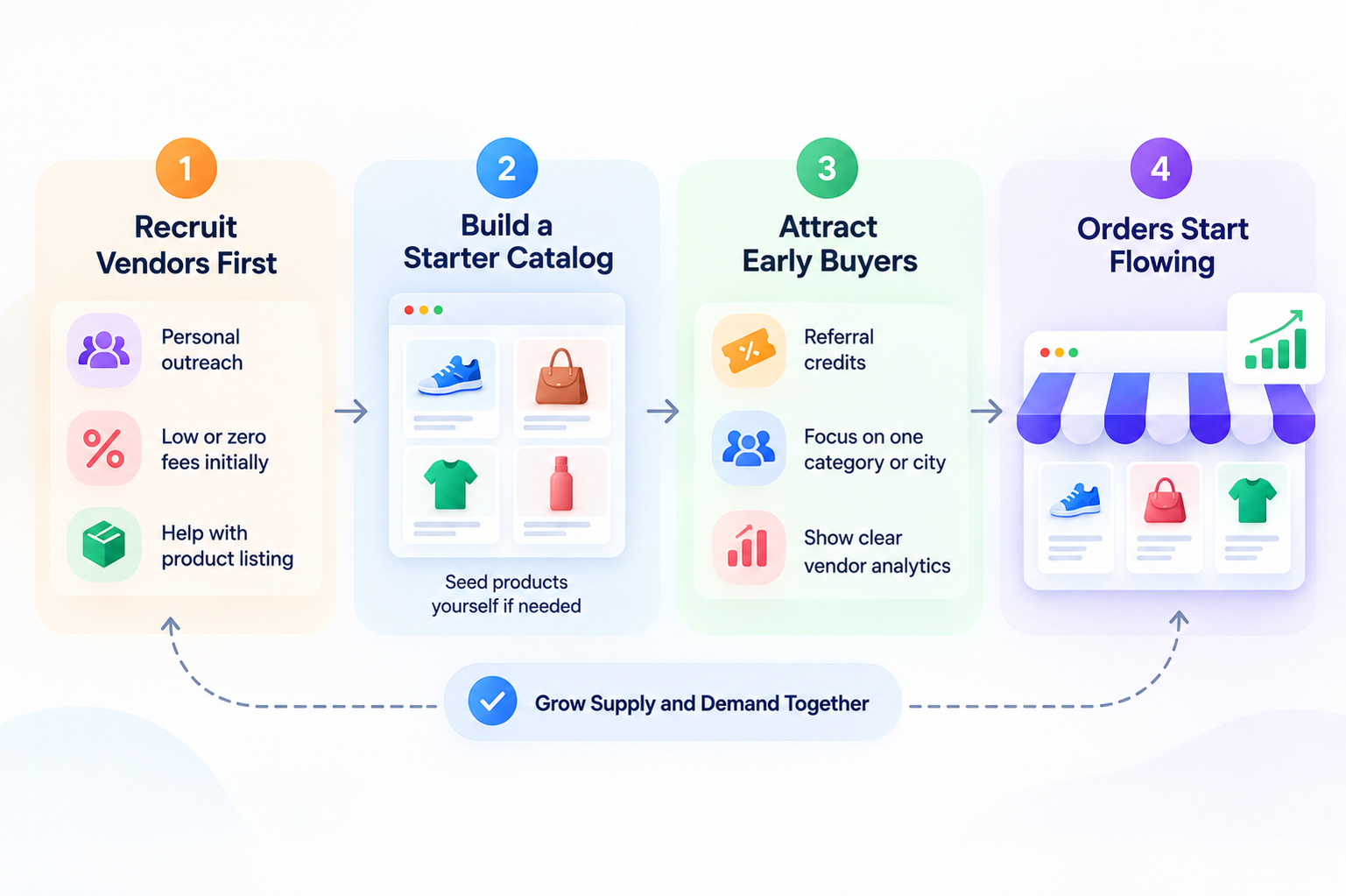
Start with supply, narrow the niche and launch in one place. Buyers will not come to an empty marketplace, so recruit vendors first with a personal pitch, low or zero fees for the first months and help listing their products. Seed the catalog yourself if needed, then focus on one category or one city until orders flow. Tools can help: bulk import for vendors, referral credits for early buyers and clear vendor analytics.
Keep the budget in mind. Growth costs often exceed build costs, so a vibe coding marketplace app in USA that leaves money for onboarding vendors beats a polished one nobody lists on. When you hire vibe coders for multi-vendor marketplace work, ask whether the team has helped other founders launch, not just build.
7.1 Should I build custom or use a marketplace platform?
Use a platform such as Sharetribe or a Shopify multi-vendor setup if your model is standard and speed matters, and build custom when your payments, matching or vendor tools are the product. A hybrid is common: start on a platform to prove demand, then build custom pieces. Ask a multi-vendor marketplace development agency to price both paths honestly, and decide this before you hire vibe coders for multi-vendor marketplace work.
7.2 What tax and 1099-K rules affect marketplaces?
Marketplaces face two main duties. First, sales tax: most states have marketplace facilitator laws that make the platform collect and remit sales tax on vendor sales, so you need a tax calculation service. Second, information reporting: payment settlement entities generally file Form 1099-K for vendors who pass the reporting threshold, and the threshold has changed more than once, so confirm the current figure with your accountant. Collect W-9 forms or equivalent details during onboarding. A vibe coding marketplace app in USA should store tax data securely and never hard-code rates.
7.3 How do you recruit the first fifty vendors?
Make a list of fifty target sellers, contact each personally, offer zero fees for the first three months and list their first products for them. Show them the dashboard before launch and ask what is missing. Early vendors become your case studies. Ask a multi-vendor marketplace development agency whether it can build bulk import and vendor analytics, since a vibe coding marketplace app in USA with those tools recruits faster.
8. Conclusion
A marketplace budget has seven lines, and vibe coding shrinks only some of them. Cut the interface cost, protect the money layer, leave room for vendor onboarding and ask every supplier to show its lines. That is how a vibe coding marketplace app in USA stays affordable without becoming fragile. When you hire vibe coders for multi-vendor marketplace work, judge them on how they price payments and testing, and choose a multi-vendor marketplace development agency that welcomes the question.
9. FAQs
How do I verify vendors safely?
Use Stripe Connect or a specialist identity provider for ID and business checks, collect tax details, screen against sanctions lists where required and review risky categories by hand. Keep a record of every approval decision.
What is the best tech stack for a marketplace?
A typed backend, a relational database, a dedicated search service, background queues, Stripe Connect and a cross-platform front end such as Flutter or React. Choose what your team can support, and ask the multi-vendor marketplace development agency why, since a vibe coding marketplace app in USA benefits from proven parts.
What are common mistakes when hiring a marketplace developer?
Choosing on the lowest total, skipping the payments conversation, accepting a demo instead of a live checkout, ignoring vendor onboarding and failing to secure code ownership. Ask for references from marketplaces that handle real payouts, before you hire vibe coders for multi-vendor marketplace work.
Why is ArixLabs a good marketplace partner?
ArixLabs builds with vibe coding under senior engineering review and has delivered 100+ production apps. We keep payout and fee logic human-reviewed, price every budget line openly and hand you code you own. If you want to hire vibe coders for multi-vendor marketplace work, we show our review process before you commit, as a multi-vendor marketplace development agency should.
%20(1).jpg)

View more blogs

.png)



.jpg)
Ready to develop your own product? Get in touch today!
Get in Touch