




Introduction
Cart abandonment on the average online store hovers around seventy percent, and a weak payment integration is often the reason why. A shopper waits three seconds too long and closes the tab, exactly the friction a build online store with React JS project eliminates. Multiply that across a few thousand visitors a month and the lost revenue adds up fast, which is why brands look for a React JS shopping website developers partner whose checkout holds up under real traffic. React JS e-commerce website development exists because storefronts on older, page-reload-heavy platforms can't compete with how instant modern shopping needs to feel, and that gap only grows as competitors invest in it themselves. Arixlabs (previously FlutterFlowDevs) has built enough of these storefronts to see the same pattern play out: a business switches to React, checkout gets faster, and conversion rates move in the right direction within weeks, whether the project started as a fresh build online store with React JS engagement or a rebuild. If you're planning React JS e-commerce website development, here's what actually goes into making that happen, from catalogs to payment gateways to the SEO work that gets a store found. Three things tend to separate a store that converts from one that doesn't:
- A catalog structure that stays fast even as products pile up
- A checkout flow with as few clicks and as little friction as possible
- A React JS store integration with payment gateway setup that shoppers actually trust, handled by a React JS shopping website developers team that treats security as core, not optional
1. Why choose React JS for building an e-commerce website?
Speed sells. That's the short version, and it's why React JS e-commerce website development keeps winning over slower, template-based alternatives, a trend showing up across every React JS e-commerce website development case study worth reading. A React JS shopping website developers team builds interfaces that update instantly when a shopper adds an item, filters a category, or applies a coupon, without the jarring full-page reloads that older e-commerce platforms are known for. This isn't a minor UX detail, it's the difference between a shopper staying on the page and a shopper bouncing to a competitor. Custom e-commerce app React JS builds also give businesses full control over the shopping experience instead of forcing every store into the same rigid template that a hosted platform provides. An e-commerce web development company can build exactly what a brand needs, whether that's a visual product configurator, a subscription checkout flow, or a marketplace connecting multiple sellers. This flexibility is why so many growing brands move away from hosted platforms toward a custom e-commerce app React JS build once their needs outgrow generic templates. None of that comes easily on platforms designed for generic, one-size-fits-all stores. A React JS shopping website developers team trades template convenience for design freedom, which matters most for brands whose product experience is part of what they're selling.
2. How is a product catalog structured in a React JS store?
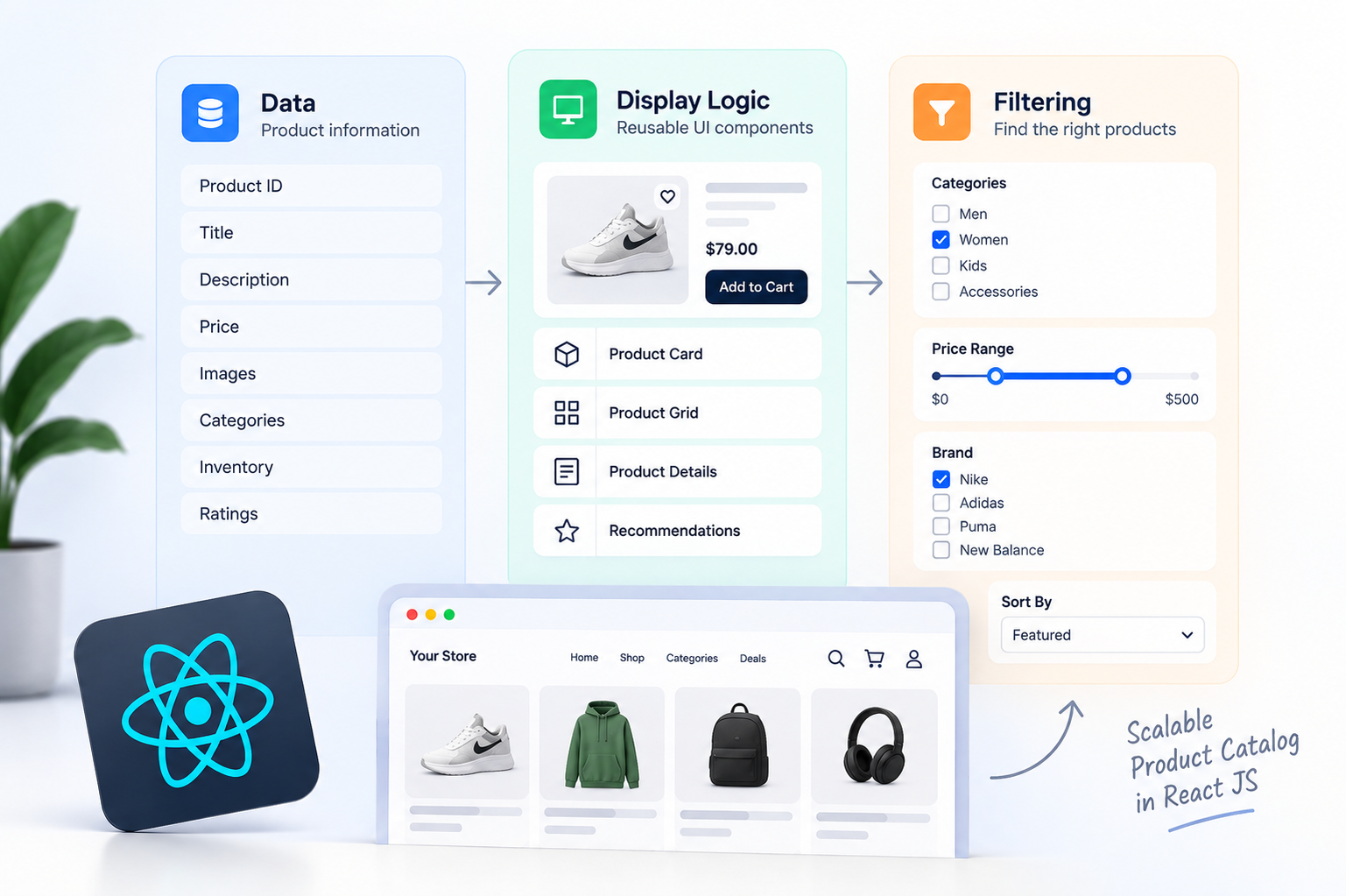
A well-built catalog for any build online store with React JS project separates three concerns: data, display logic, and filtering. Keeping these separate means a React JS e-commerce website development project can redesign the storefront's look without touching how product data flows underneath it, a separation that also makes it easier for a React JS shopping website developers team to hand off maintenance later without weeks of onboarding. Large catalogs benefit enormously from this structure since a component built once for "product card" gets reused across category pages, search results, and recommendation widgets without duplicating code six different ways, a pattern any competent e-commerce web development company should default to without being asked. For a business planning to build online store with React JS around thousands of SKUs, this reusability keeps the codebase manageable as the catalog grows instead of turning into an unmaintainable mess, a common outcome any React JS shopping website developers team should design against early. A React JS e-commerce website development project that gets this separation right on day one rarely needs a catalog rebuild later, even as the product count grows tenfold.
2.1 Can React JS integrate with Shopify or WooCommerce backends?
Yes, through a headless commerce setup. Shopify and WooCommerce both offer APIs a React JS frontend can call directly, so a business keeps its existing product management tools while gaining a completely custom, much faster storefront, the kind a custom e-commerce app React JS build is typically defined by. This hybrid approach is popular with a React JS shopping website developers team asked to modernize the frontend without disrupting an operations team already comfortable with their existing backend tools, and it's a common starting point for a custom e-commerce app React JS engagement scoped around a tight budget.
3. How are payment gateways integrated into a React JS e-commerce site?
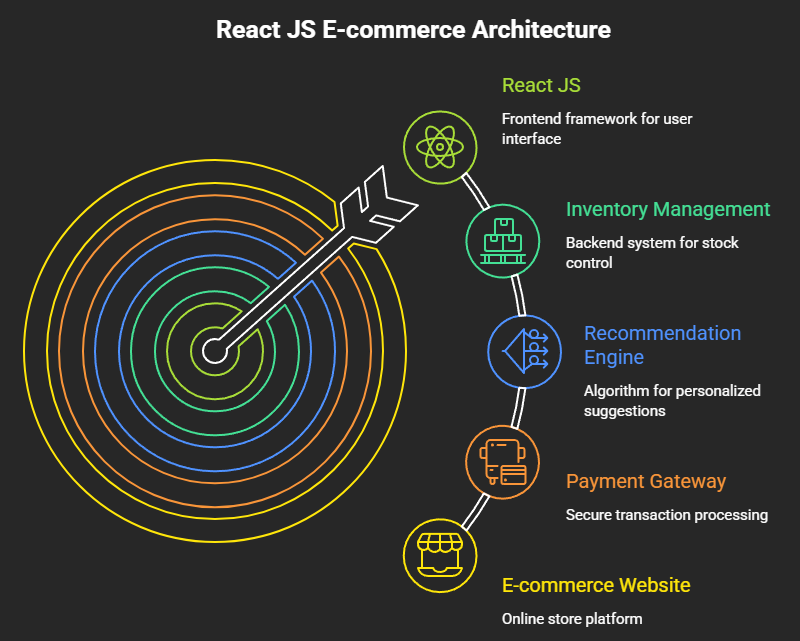
Most React JS store integration with payment gateway work happens through the provider's official SDK or a hosted checkout page, keeping sensitive card data away from the store's own servers, the standard approach across nearly every serious e-commerce web development company today. Stripe, Razorpay, and PayPal all offer React-friendly libraries that handle the tricky parts, tokenization, 3D Secure verification, currency conversion, without the business needing to build any of that from scratch, one reason a React JS store integration with payment gateway setup rarely takes as long as founders expect. A custom e-commerce app React JS build typically wires the payment flow directly into the checkout component, so the transition from cart to confirmation feels like one continuous step instead of a jarring redirect to a separate page. Security compliance matters for any React JS store integration with payment gateway build. PCI DSS requirements are largely handled by the provider when integration follows their pattern, one less thing an e-commerce web development company needs to build in-house on any React JS store integration with payment gateway project. A properly wired React JS store integration with payment gateway also handles failed transactions gracefully, showing a clear retry option instead of a dead end that sends a frustrated shopper elsewhere.
3.1 What security measures protect customer data on a React JS site?
HTTPS encryption, tokenized payment data that never touches the store's own servers as part of any React JS store integration with payment gateway setup, and regular dependency updates to patch known vulnerabilities form the baseline. Beyond that, rate limiting on login attempts and proper session handling close off the most common attack vectors on any e-commerce site. A trustworthy React JS store integration with payment gateway setup treats these as non-negotiable from the first sprint, a standard any serious e-commerce web development company or React JS shopping website developers team should hold itself to regardless of budget.
4. How does React JS improve checkout speed and conversions?
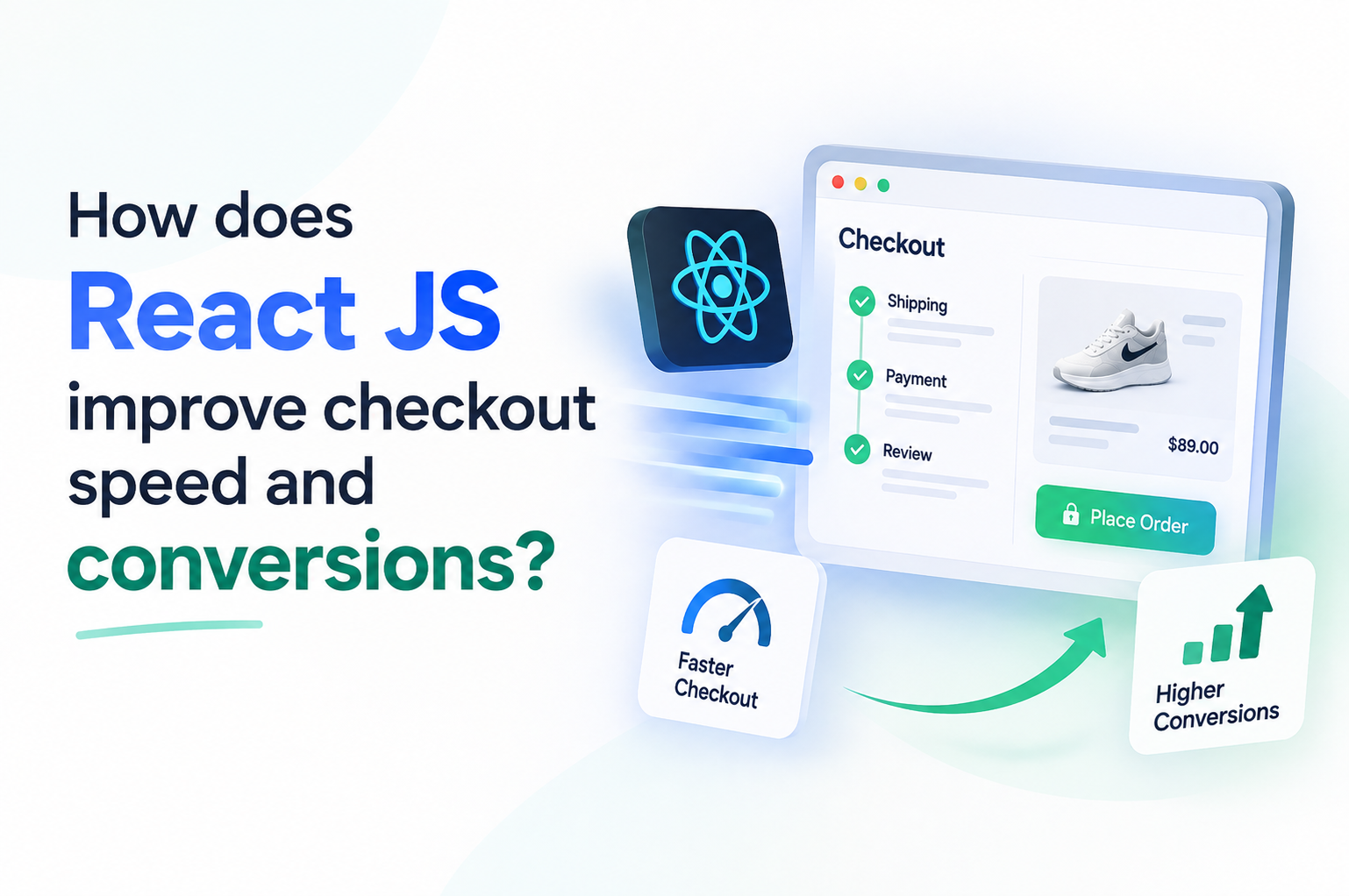
Every extra second at checkout costs conversions, and React JS attacks that problem from a few angles at once. Form fields validate instantly instead of waiting for a page reload to flag an error. Cart totals update live as items get added or removed. Address autofill and saved payment methods cut the number of fields a returning customer has to type. A React JS e-commerce website development team focused on conversion strips checkout down to essentials, removing distracting navigation or upsell popups that interrupt the moment someone is trying to pay, exactly what a custom e-commerce app React JS build should prioritize. Guest checkout matters here too. Forcing an account creation before purchase is one of the fastest ways a build online store with React JS project can quietly lose sales it already had in hand. Small technical choices compound here. A build online store with React JS project that lazy-loads product images and defers non-critical scripts routinely shaves a full second off page load, and that second matters more at checkout than anywhere else on the site.
4.1 How is cart and wishlist functionality built in React JS?
Cart state typically lives in a global store, Redux or Context API, so it stays consistent across every page without a server round-trip, a build online store with React JS pattern that keeps the shopping experience fast. Wishlists follow the same pattern, usually synced to a user account once someone logs in so the list persists across devices. This kind of state management is exactly where a custom e-commerce app React JS build outpaces a hosted platform's rigid cart, giving a React JS shopping website developers team and any e-commerce web development company room to add features a template can't support.
5. How is inventory management connected to a React JS storefront?
Inventory sits behind the storefront, usually in a dedicated system or the backend database, and the React JS frontend queries it in real time to show accurate stock levels. This connection matters most during a flash sale or product launch, when overselling a limited item creates refund headaches, exactly the scenario a good React JS e-commerce website development plan accounts for before launch day, not during it. A React JS shopping website developers team typically builds in a buffer, showing "low stock" warnings before an item actually sells out, which nudges hesitant shoppers toward a decision while giving the backend a moment to sync. This kind of detail is exactly what separates a generic e-commerce web development company build from one that actually understands retail psychology. For multi-channel sellers running the same inventory across a website, a marketplace, and a physical store, a custom e-commerce app React JS build needs to sync stock levels frequently enough that customers never see a product as available when it's actually gone. This is one area where a generic template rarely holds up, a common reason businesses eventually commission a custom e-commerce app React JS project rather than continuing to patch a hosted platform's limitations, complete with an e-commerce web development company handling the payment layer properly this time.
5.1 What role does React play in personalized product recommendations?
React handles the display layer for a React JS e-commerce website development build, rendering recommendation widgets that pull from a recommendation engine or simple purchase-history logic on the backend. The framework's speed means these widgets can update dynamically as a shopper browses, showing different suggestions based on what's currently in their cart or view history. This kind of feature fits naturally into a build online store with React JS project, since recommendation widgets slot into an existing catalog without disrupting the React JS store integration with payment gateway or anything else already built.
6. How do you optimize a React JS e-commerce site for search engines?
E-commerce SEO lives or dies on product pages, since that's where organic traffic actually converts into sales. Server-side rendering through Next.js is close to essential for React JS e-commerce website development, since search engines need to see fully rendered product details, not a blank page waiting on JavaScript. Structured data markup for products, prices, and reviews helps listings show up with rich snippets in search results, which noticeably improves click-through rates, a detail every React JS shopping website developers team should build in from the start rather than retrofit later. An e-commerce web development company handling React JS SEO work will also flatten the URL structure so category and product pages are easy for search engines to crawl, and will make sure every product page has unique, keyword-relevant content instead of thin, duplicate descriptions copied straight from a manufacturer's spec sheet. None of this is unique to React, but rendering quirks make it easy to get wrong without proper server-side rendering, a mistake a seasoned React JS e-commerce website development team learns to catch early on a build online store with React JS project.
6.1 How is mobile responsiveness handled for React JS stores?
Responsive design in React JS typically relies on flexible grid layouts and component-level breakpoints, so a product page reflows cleanly from a desktop screen down to a phone without separate mobile and desktop codebases. Given that most e-commerce traffic now arrives on mobile, this isn't optional polish, it's the primary experience most shoppers will actually have. An e-commerce web development company that treats mobile as an afterthought on a build online store with React JS project is building for a shrinking share of actual visitors, and it's the kind of oversight a custom e-commerce app React JS build should never ship with.
Frequently Asked Questions
Is React JS suitable for large product catalogs?
It's actually one of its strengths. Component reuse and efficient rendering mean a React JS e-commerce website development project handles ten thousand products about as smoothly as it handles a hundred, provided the backend and search infrastructure scale alongside it. Most React JS shopping website developers will point to catalog size as one of the least risky parts of a large build, and any React JS shopping website developers freelancer would say the same.
Can I integrate Razorpay or Stripe into a React JS store?
Yes, both offer well-documented React libraries built for exactly this kind of build online store with React JS integration. A React JS store integration with payment gateway setup using either provider typically takes a few days for a standard flow, longer for custom logic like split payments or subscriptions, common in a custom e-commerce app React JS build serving B2B customers.
Does a React JS e-commerce site load faster than WordPress stores?
Generally, yes, particularly for interactive elements like filtering, cart updates, and checkout steps. A well-optimized custom e-commerce app React JS build avoids the plugin bloat slowing down many WordPress and WooCommerce stores, and it's one of the most common reasons businesses approach an e-commerce web development company for a rebuild, React JS store integration with payment gateway included.
Can an existing online store be rebuilt in React JS?
Absolutely, and it doesn't require starting from zero, even the React JS store integration with payment gateway can migrate cleanly. An e-commerce web development company can rebuild the frontend while keeping the existing product data, order history, and backend systems intact, migrating the storefront in phases rather than all at once. This phased approach is the fastest path to build online store with React JS without pausing sales, keeping payments live throughout.
%20(1).jpg)

View more blogs



.png)

.png)
.png)
%20%5Bweb-search%5D_a_Generate_a_cover_ima%20(1).png)

.png)
Ready to develop your own product? Get in touch today!
Get in Touch